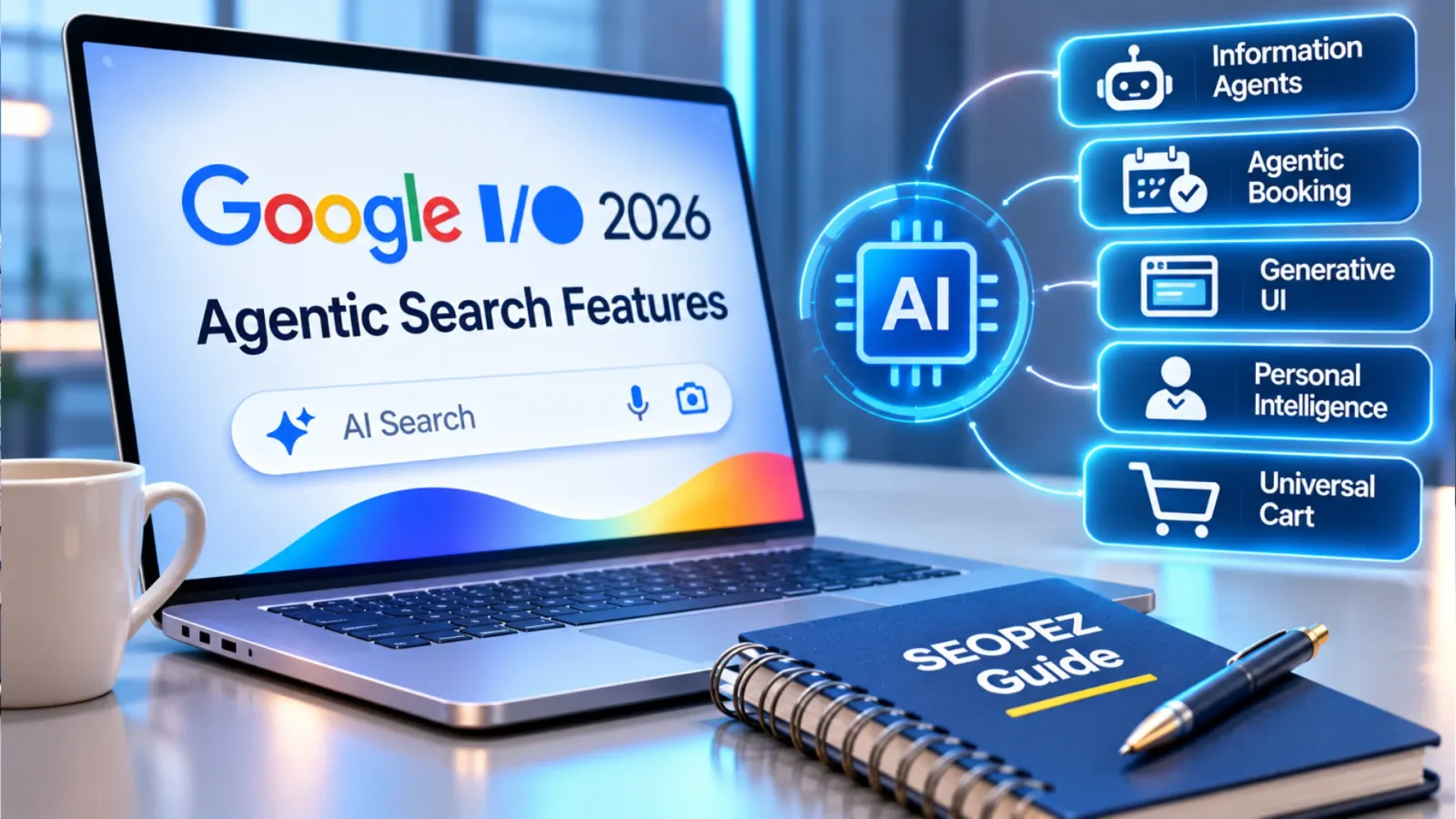
Google I/O 2026 agentic search features, as described in the article, include an AI-powered Search box, information agents, agentic booking, generative interfaces, personalized experiences, and Universal Cart. These capabilities expand search beyond traditional results toward task completion and AI-assisted decisions. Businesses can adapt by improving technical SEO, structured content, entity clarity, and AI visibility measurement.
Google I/O 2026 Agentic Search Features changed the SEO conversation from “how do we rank?” to “how do we stay useful when Search can reason, monitor, compare, summarize, and act?” Google announced an AI-powered Search box, information agents, agentic booking, generative UI, expanded Personal Intelligence, and Universal Cart. These features move Google Search closer to a task system, not only a results page. For brands, the risk is visibility loss across AI Mode, AI Overviews, agent updates, and zero-click journeys. SEOPEZ helps businesses respond with structured content, technical SEO, GEO planning, and AI-search-ready measurement.
Quick Check
If your visibility depends on Google Search, AI Mode, or generative answers, SEOPEZ can review the gap through ai seo optimization built around crawlability, entity clarity, topical depth, and AI-search measurement.
Google I/O 2026 Agentic Search Features Explained
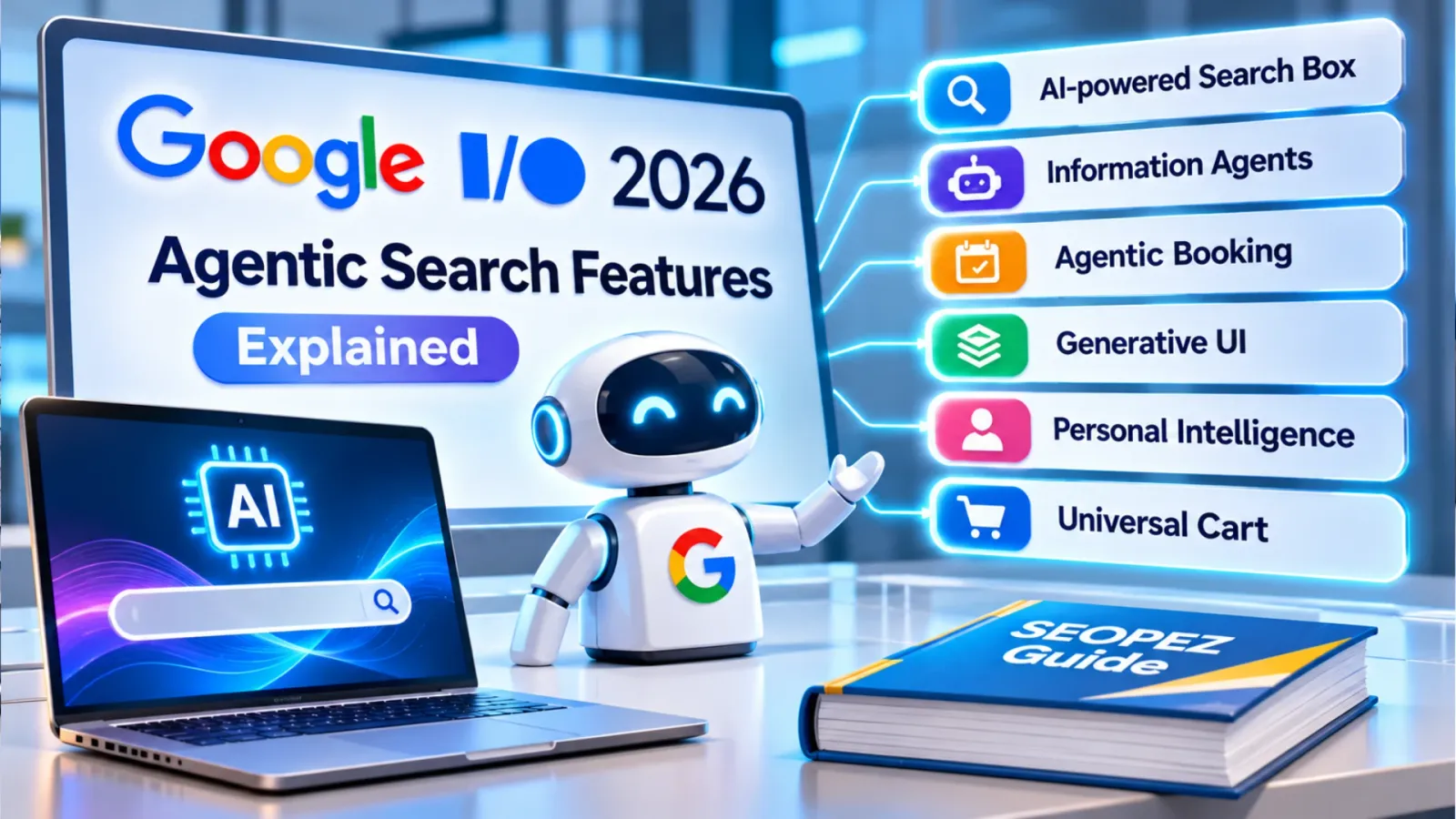
Google I/O 2026 Agentic Search Features are a group of Search updates that make Google more conversational, multimodal, personalized, and action-oriented. Google said the new AI-powered Search box is the biggest upgrade to the Search box in more than 25 years, and AI Mode now uses Gemini 3.5 Flash as the default model globally.
Google I/O 2026 Search feature map
| Feature | What changed | SEOPEZ priority |
|---|---|---|
| AI-powered Search box | Users can search with text, images, files, videos, and Chrome tabs where AI Mode is available | Build content that answers complex prompts, not only short keywords |
| Information agents | Search agents can monitor blogs, news, social posts, finance, shopping, sports, and fresh data | Strengthen source clarity, freshness, and entity consistency |
| Agentic booking | Search can combine pricing and availability, then send users to providers to finish booking | Make service pages crawlable, specific, and conversion-ready |
| Generative UI | Search can build custom layouts, tables, graphs, simulations, dashboards, and mini apps | Structure content as definitions, steps, comparisons, and decision frameworks |
| Personal Intelligence | AI Mode can connect Google apps with user control in supported contexts | Expect more personalized search journeys and less uniform SERP behavior |
| Universal Cart | Shopping can work across Search, Gemini, YouTube, and Gmail | Keep product data, merchant details, and checkout paths accurate |
This shift matters because AI Search does not only retrieve pages. It interprets the user’s task, expands the query, evaluates sources, and may complete part of the journey inside Google. SEOPEZ approaches Google I/O 2026 Agentic Search Features as a visibility architecture problem: content, technical SEO, structured data, brand signals, and measurement need to work together.
Google’s own guidance still says SEO remains relevant for generative AI Search because AI features are rooted in core Search ranking and quality systems. Google also emphasizes technical structure, crawlability, unique useful content, Search Console reporting, and agentic website readiness.
AI Mode Turns Keywords Into Tasks
Google I/O 2026 Agentic Search Features make AI Mode central to the search journey. The new Search box can dynamically expand, help users formulate better prompts, and move from AI Overviews into AI Mode follow-up conversations while keeping context.
That means the old keyword-only content brief is too narrow. A user may start with “Google I/O 2026 Agentic Search Features,” then ask how it affects ecommerce, local SEO, B2B lead generation, content strategy, or Search Console reporting. A page that only summarizes the announcement may lose visibility when the AI system needs a deeper answer.
SEOPEZ handles this by mapping query layers. The main keyword anchors the page, but supporting sections answer adjacent intent: what changed, why it matters, what to measure, what to fix, and what to publish next. This is where an internal resource on the AI search behavior shift helps readers understand why search journeys are becoming longer, more conversational, and less dependent on one visible query.
Query Fan-Out Expands the Hidden SERP
Google I/O 2026 Agentic Search Features are also tied to query fan-out. Google says AI Overviews and AI Mode may issue multiple related searches across subtopics and data sources to develop a response.
This matters because the visible user prompt is not the full search event. One prompt can trigger related subtopics such as definitions, examples, comparisons, limitations, statistics, service criteria, and follow-up actions. A brand that ranks for only the headline phrase may still be absent from the supporting sources used inside the answer.
SEOPEZ builds content around this hidden expansion. A page should include the core answer, but also the surrounding evidence a search system may need: definitions, mechanics, examples, risks, implementation steps, and measurement advice. The subquery expansion process is useful for teams planning pages around AI Mode rather than only classic keyword lists.
Search Agents Make Freshness Continuous
The information-agent update is one of the most important Google I/O 2026 Agentic Search Features. Google said users will be able to create, customize, and manage multiple AI agents in Search, starting with information agents that operate in the background, reason across web sources, and monitor changes related to a user’s specific question.
For SEO teams, this changes the meaning of freshness. Search agents are not only answering a one-time query. They can monitor topics, send synthesized updates, and help users act when something changes. That makes stale content, vague publication dates, thin updates, and disconnected topic clusters harder to defend.
SEOPEZ prioritizes update systems for agentic Search. That includes reviewing old pages, adding current context, improving internal links, clarifying entity relationships, and removing outdated claims. It also means building off-site and on-site signals that support recognition beyond a single page. The unlinked mention signal pattern helps explain why brand references can matter when AI systems evaluate broader web context.
Zero-Click Pressure Is a Measurement Problem
Google I/O 2026 Agentic Search Features increase the chance that users get more of the answer before clicking. AI Overviews, AI Mode, generated layouts, information agents, and agentic booking can all reduce the need for immediate website visits in some journeys.
Independent research has found evidence that AI search interfaces can reduce publisher referrals. A 2026 preregistered field experiment reported that AI Mode-only experiences reduced click-through to publishers compared with current Google Search during the study.
SEOPEZ does not treat this as a reason to stop investing in SEO. It treats it as a reason to measure differently. Organic sessions still matter, but they must sit beside AI visibility, citation presence, branded search demand, lead quality, assisted conversions, and Search Console generative AI reporting.
The practical issue is covered in the zero-click discovery pattern. A brand can lose traffic while still influencing decisions inside Search. The job is to connect visibility, trust, and conversion paths instead of measuring success only by clicks.
Agentic Booking Changes Service Pages
Google I/O 2026 Agentic Search Features include expanded agentic booking. Google said users can share specific criteria and Search can bring together pricing and availability with links to finish booking through the provider. Google also said selected U.S. categories such as home repair, beauty, and pet care can use call-on-your-behalf capabilities.
For service businesses, this makes page clarity more important. A service page should not hide essential details inside vague copy. It should explain what is offered, who it is for, what conditions apply, where the service is available, how users take the next step, and why the provider is credible.
SEOPEZ uses google seo optimization to make service pages easier for both users and search systems to interpret. That includes crawlable text, structured internal linking, technical health, clear service definitions, schema where appropriate, and conversion paths that match the user’s intent.
Generative UI Rewards Clear Structure
Google I/O 2026 Agentic Search Features also include generative UI in Search. Google said Search can create custom layouts, interactive visuals, tables, graphs, simulations, dashboards, trackers, and mini apps based on the user’s task.
This makes structured explanation more valuable. A page should not read like a loose essay if the topic requires a process, comparison, or decision path. It should contain clear definitions, scannable tables, logical sections, FAQs, and internal links that reinforce the next learning step.
Content structures for agentic Search
| Structure | Why it matters for AI Search | SEOPEZ use case |
|---|---|---|
| Definition block | Helps systems identify the topic boundary | Explain what the feature is and what it is not |
| Comparison table | Helps AI summarize trade-offs | Compare classic SEO, GEO, AEO, and AI Mode visibility |
| Process section | Helps Search turn content into steps | Show how to audit pages after Google I/O 2026 |
| FAQ set | Supports follow-up questions | Answer practical questions from marketers and site owners |
| Schema-aligned content | Improves eligibility for rich search surfaces | Match visible content with structured data where useful |
| Internal topic cluster | Reinforces related concepts | Connect AI Search, technical SEO, content, schema, and measurement |
SEOPEZ applies this structure through practical page design. Content should be useful to humans first, but it should also be easy for AI systems to parse. The content refinement framework helps teams improve pages without turning them into keyword-stuffed assets.
GEO, SEO, and AEO Must Work Together
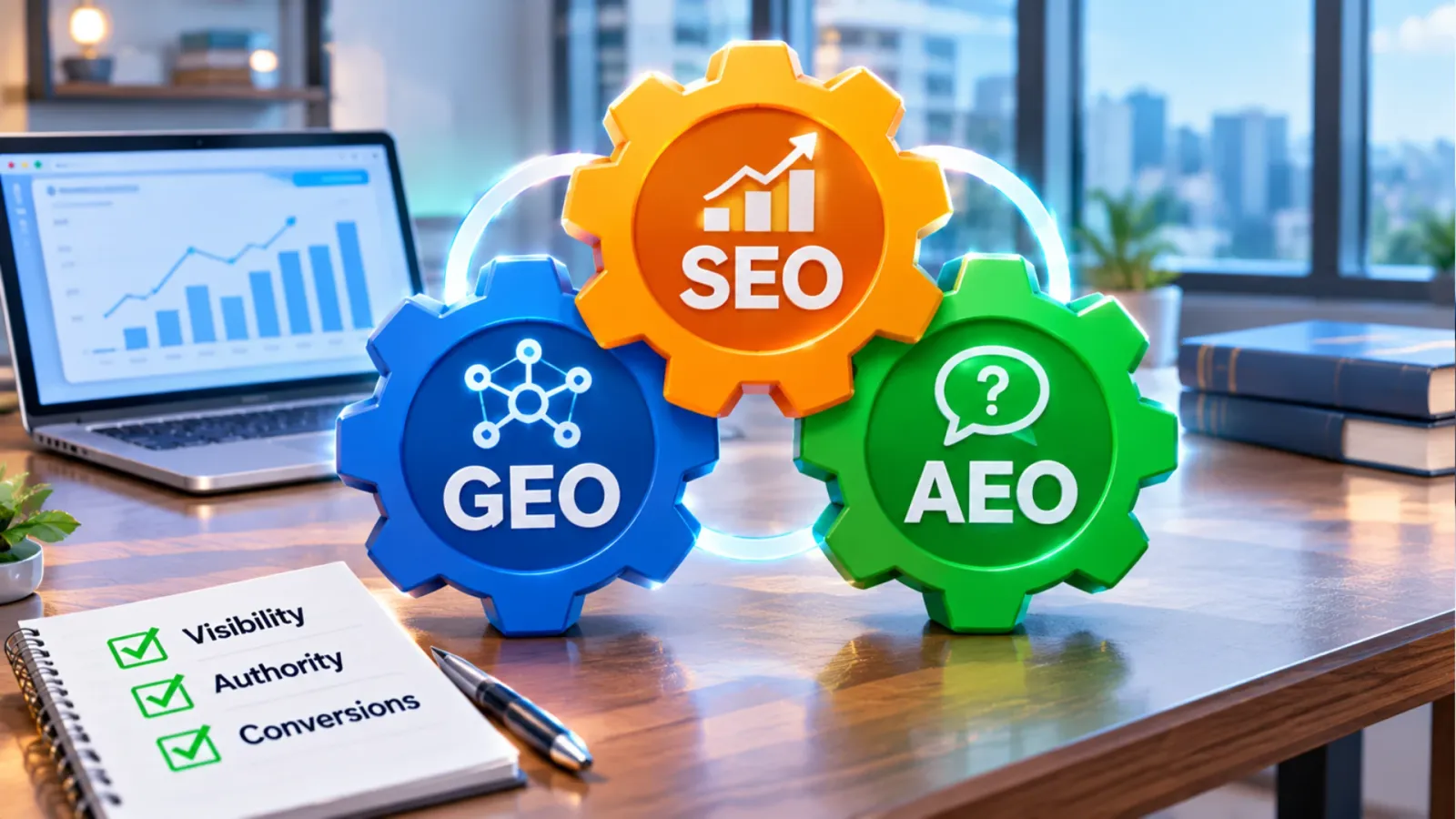
Google I/O 2026 Agentic Search Features create confusion because marketers often separate SEO, GEO, and AEO too sharply. In practice, they overlap.
SEO still covers crawlability, indexing, relevance, authority, content quality, internal links, and technical structure. GEO focuses on how content appears, gets cited, or influences generative AI responses. AEO focuses on answer extraction, direct answers, and concise response formats. Google’s guidance says there are no special AI-only technical requirements for AI Overviews or AI Mode beyond being indexed and eligible to appear with a snippet, but foundational SEO remains important.
The useful distinction is operational. SEOPEZ uses the GEO SEO AEO comparison model to decide what each page needs: technical access, answer clarity, source credibility, entity consistency, or deeper topical coverage.
A related resource on generative engine fundamentals helps teams avoid treating GEO as a shortcut. GEO cannot replace strong SEO foundations. It adds another visibility layer on top of them.
Citation Selection Is Not Classic Ranking
Google I/O 2026 Agentic Search Features make AI citation behavior more important. If an AI response includes supporting links, the chosen source may not always match the classic organic ranking order.
A 2026 study of Google AI Overviews reported that nearly 30% of cited pages did not appear in co-displayed first-page organic results, suggesting that AI citation selection can differ from traditional ranking.
For SEOPEZ, this means AI Search Optimization needs a dual lens. Pages should still be built to rank, but they must also be useful as sources: clear, specific, current, well-structured, and connected to a recognizable entity. The AI citation divergence factors resource helps explain why a ranking report alone may miss the real visibility gap.
This is also where research-backed GEO matters. The Princeton GEO citation findings are relevant for teams studying how citations, statistics, and source framing may influence generative engine visibility. The practical lesson is not to manufacture claims. It is to publish verifiable, well-supported, topic-specific information.
Source Quality Depends on Entity Signals
Google I/O 2026 Agentic Search Features increase the value of brand clarity. AI systems need to understand who the business is, what it does, what it knows, and where it fits in the topic graph.
A weak page may mention the right keyword but fail to establish the entity. A stronger page connects the brand, service, problem, evidence, process, and next step. For SEOPEZ, that means building content where SEOPEZ is not only mentioned in the CTA, but naturally tied to the solution throughout the page.
The AI source selection criteria resource fits here because different AI systems evaluate sources through signals such as relevance, clarity, freshness, consistency, and usefulness. The safest long-term approach is not to chase hidden formulas. It is to make the brand easier to understand and trust.
Off-page work still supports this effort. The authority signal development process helps explain why credible references, brand mentions, and topical association still matter in an AI Search environment.
New Websites Need AI-Ready Foundations
Google I/O 2026 Agentic Search Features create pressure for established brands, but new websites are especially exposed. A new site may lack crawl history, internal depth, external references, entity recognition, and Search Console data.
SEOPEZ builds new websites with AI Search in mind from the start. That means clean architecture, clear page purposes, crawlable navigation, strong internal links, service-specific copy, schema where useful, and content that answers real decision questions. The new website SEO foundation is important because a weak base becomes harder to fix once AI systems have limited evidence about the brand.
Common mistakes also become more costly. Thin pages, duplicate service copy, missing internal links, slow rendering, vague titles, and unsupported claims can reduce both traditional visibility and AI usefulness. The ranking loss mistake checklist helps identify issues before they become structural problems.
On-Page and Technical SEO Still Matter
Google I/O 2026 Agentic Search Features do not remove the need for on-page SEO. They raise the standard. Google says important content should be available in textual form, internal links should make content findable, structured data should match visible text, and pages must meet Search technical requirements to be eligible as supporting links in AI Overviews or AI Mode.
SEOPEZ audits titles, headings, introductions, internal links, topical coverage, schema alignment, page speed, indexability, and UX. The goal is not only to rank a page, but to make the page understandable enough to support AI-generated answers.
The on-page element sequence supports this work at the page level, while the technical crawling checklist helps non-developers understand how crawl access, indexability, rendering, and structure affect visibility.
Schema is part of the same system. Google says there is no special schema required for AI features, but structured data still helps with rich result eligibility when it matches visible text. The structured data basics resource gives teams a practical foundation without overstating schema as an AI shortcut.
Keyword Research Becomes Prompt Research
Google I/O 2026 Agentic Search Features do not kill keyword research. They expand it. Keyword research now needs to include prompts, comparisons, decision criteria, follow-up questions, and hidden fan-out topics.
A classic keyword list may show search volume, but AI Mode behavior can reveal task complexity. SEOPEZ combines keyword mapping with prompt mapping so content can answer the main query and the likely next questions.
The search intent mapping method helps teams build from keywords into topic architecture. For Google I/O 2026 Agentic Search Features, this means mapping not only “what people search,” but also “what an AI system may need to retrieve to answer well.”
Gen Z behavior also makes this important. The AI-first discovery habits resource is relevant because younger users increasingly move across search engines, social platforms, and AI assistants when researching. SEOPEZ treats this as a cross-surface visibility challenge rather than a single-platform SEO issue.
Measurement Must Include Generative AI Reports
Google I/O 2026 Agentic Search Features require better reporting. Google launched Search Generative AI performance reports in Search Console in June 2026 and said these reports include dedicated views for impressions in generative AI features such as AI Overviews, AI Mode, and generative AI features in Discover.
Google said the reports show information such as impressions, pages, countries, devices, and dates, and noted worldwide rollout as of August 31, 2026.
SEOPEZ uses this measurement layer alongside classic SEO data. Ranking reports, traffic reports, crawl reports, and conversion reports still matter, but they must be interpreted with AI exposure in mind. The Search Console performance review is the baseline for understanding Google data. The AI search reporting stack extends that view into GEO and AI visibility workflows.
How SEOPEZ Prioritizes the Response?
Google I/O 2026 Agentic Search Features point to one clear strategy: make the brand easier for users and AI systems to understand, verify, compare, and act on. That requires more than publishing a trend summary.
SEOPEZ starts with a visibility audit. The audit checks whether key pages are crawlable, indexed, internally linked, structured, current, entity-rich, and aligned with user intent. It also reviews whether content answers the prompt variations that AI Mode and query fan-out may generate.
Then SEOPEZ builds or improves the content system. That includes topic clusters, service pages, informational assets, schema alignment, internal linking, and reporting dashboards. For global SEO audiences, this matters because Google I/O 2026 Agentic Search Features affect SaaS, ecommerce, publishers, agencies, local businesses, service providers, and B2B companies differently.
If your website needs to adapt to Google I/O 2026 Agentic Search Features, SEOPEZ can connect the technical, content, GEO, and measurement work into one operating plan. Start with ai seo optimization to review where your pages stand across AI Mode visibility, crawlability, topical depth, internal links, and generative search reporting. The aim is not to chase every AI trend. The aim is to make your brand consistently useful where Google Search is becoming more agentic.
FAQs About Google I/O 2026 Agentic Search Features
What are Google I/O 2026 Agentic Search Features?
Google I/O 2026 Agentic Search Features are Search updates that let Google do more of the work behind a query. They include an AI-powered Search box, information agents, agentic booking, generative UI, expanded Personal Intelligence, and commerce tools such as Universal Cart. The main SEO impact is that Search can now interpret broader tasks, monitor fresh information, generate response formats, and support actions before the user reaches a website.
Why do Google I/O 2026 Agentic Search Features matter for SEO?
Google I/O 2026 Agentic Search Features matter because visibility can happen inside AI Mode, AI Overviews, agent updates, generated dashboards, and booking flows. A page may influence the decision without receiving the same click pattern as classic organic results. SEO teams need to preserve technical SEO fundamentals while adding GEO planning, source clarity, entity consistency, structured explanations, and reporting that includes generative AI exposure.
How does query fan-out affect Google I/O 2026 Agentic Search Features?
Query fan-out affects Google I/O 2026 Agentic Search Features because AI Mode and AI Overviews may issue multiple related searches to build one answer. That means a visible prompt can create hidden demand for definitions, examples, comparisons, requirements, limitations, and next steps. SEOPEZ plans pages around those supporting subtopics so content has a stronger chance of being useful across the full AI-generated answer path.
Do Google I/O 2026 Agentic Search Features replace traditional SEO?
Google I/O 2026 Agentic Search Features do not replace traditional SEO. Google’s guidance says foundational SEO best practices remain relevant for AI Overviews and AI Mode. Pages still need to be crawlable, indexed, useful, internally linked, technically sound, and eligible to appear in Search. What changes is the visibility layer: brands also need to think about AI citations, prompt coverage, entity clarity, and generative search reporting.
How should service businesses prepare for agentic booking?
Service businesses should prepare for agentic booking by making service information specific, crawlable, and easy to act on. Pages should explain service types, conditions, locations or audience fit, booking steps, proof, FAQs, and contact paths. If Search can compare availability, pricing, and service options, vague pages become weaker. SEOPEZ improves service pages so both human visitors and AI systems can understand what the business offers.
What content format works for Google I/O 2026 Agentic Search Features?
The strongest format for Google I/O 2026 Agentic Search Features is structured, evidence-based, and task-focused. A page should include a clear definition, a practical breakdown, comparison tables, process sections, FAQs, internal links, and visible text that supports any structured data. This makes content easier for people to scan and easier for AI systems to summarize, cite, or transform into generative UI elements.
How should brands measure Google I/O 2026 Agentic Search Features?
Brands should measure Google I/O 2026 Agentic Search Features with both classic SEO metrics and AI Search metrics. Organic traffic, rankings, conversions, and Search Console performance still matter. But teams should also review generative AI impressions, pages appearing in AI features, country and device visibility, citation presence, branded search movement, and assisted conversion quality. A traffic-only report may miss influence that happens before the click.
Want us to handle it for you?
See the sites, the numbers and the price before you order.