
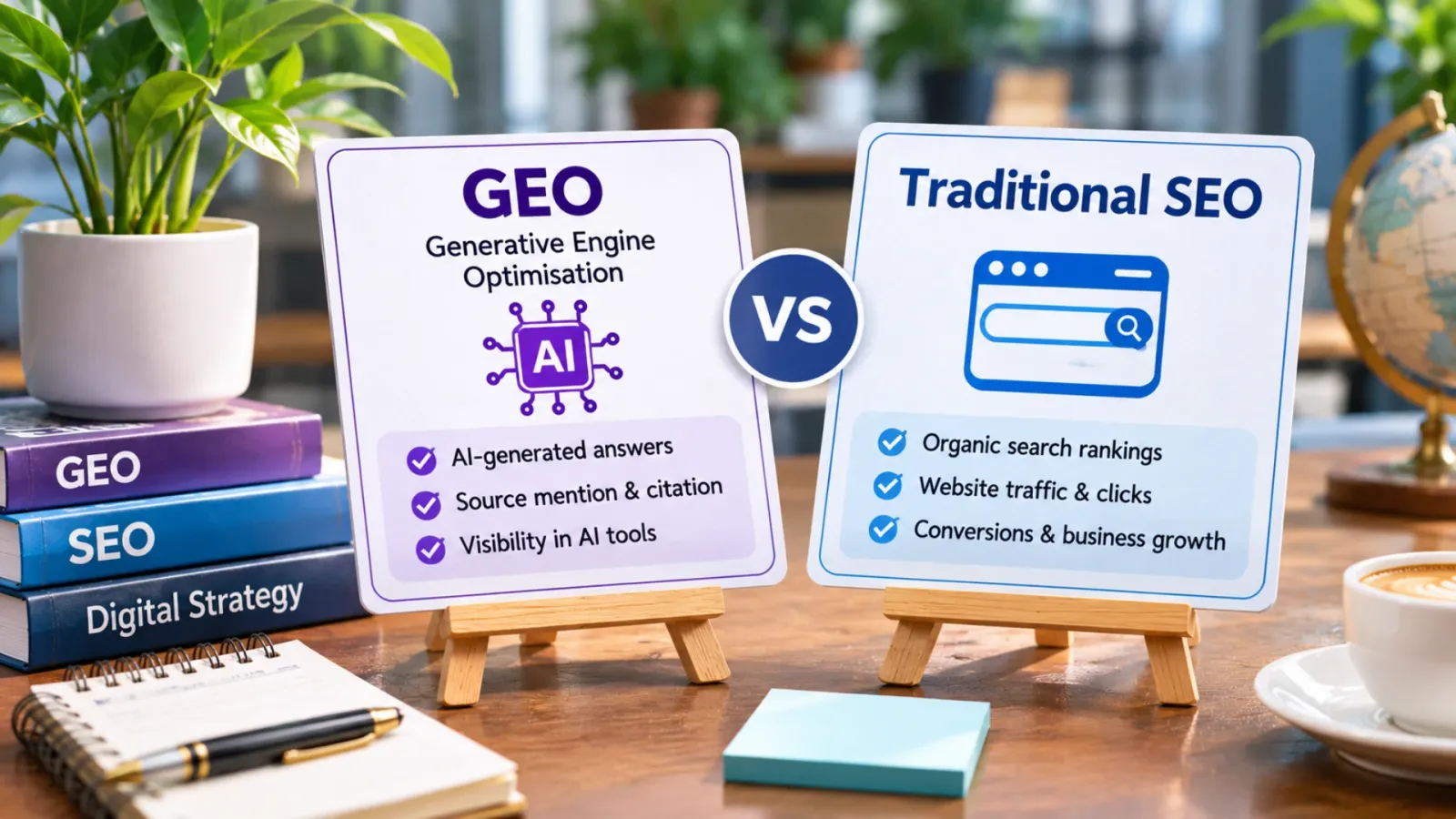
Traditional SEO focuses on improving website visibility through organic search rankings, crawling, indexing, and relevant content. Generative Engine Optimization (GEO) focuses on how content and business information appear in AI-generated answers, including mentions and citations. Combining both approaches helps businesses strengthen search visibility while measuring rankings, AI appearances, referral traffic, and conversions separately.
Businesses are being told that traditional SEO is outdated and GEO is the new route to online visibility. That reaction can lead teams to abandon proven search foundations for unverified tactics, special files, excessive schema, or unreliable AI citation tools. The experienced solution is to understand what genuinely changes, retain the SEO systems that still control discovery, and measure AI visibility without confusing mentions, crawler requests, website visits, and commercial results.
The difference begins with the surface where visibility appears. SEO generally competes for ranked listings that encourage website visits. GEO examines whether a source, statement, brand, or page becomes visible within an AI-generated response.
| Comparison factor | Traditional SEO | GEO |
|---|---|---|
| Main visibility surface | Organic search listings | AI-generated answers |
| Common outcome | Impression, ranking, and click | Source appearance, mention, or citation |
| Content evaluation | Page and passage relevance | Retrieval, selection, and answer contribution |
| User journey | Searcher chooses a result | System synthesises information first |
| Core measurement | Rankings, clicks, traffic, conversions | AI impressions, appearances, referrals, conversions |
| Essential foundation | Crawlable, indexable, useful pages | The same SEO foundation plus AI visibility analysis |
What Is Traditional SEO? It is the process of helping search engines discover, understand, index, and rank webpages for relevant searches. A complete strategy includes the keyword research process, content quality, technical access, internal relationships, authority development, and conversion-focused page experience.
What Is Generative Engine Optimisation (GEO)? It is the practice of improving how content and brand information may be retrieved, interpreted, cited, mentioned, or incorporated into generated answers. It is not a guaranteed method for controlling AI responses, because different systems, prompts, locations, retrieval methods, and repeated tests can produce different results.
The main difference is therefore not “old optimisation versus new optimisation.” It is ranked-page visibility versus generated-answer visibility, with substantial overlap underneath. Businesses need both views because a source appearance can build awareness, while the website still needs to earn trust and convert the people who visit.
Traditional SEO Still Builds the Search Foundation
AI-powered discovery cannot rescue pages that search systems cannot properly access or understand. Traditional SEO establishes the technical and editorial conditions that make information eligible for discovery. Without that foundation, GEO becomes measurement without a dependable source base.
Traditional SEO starts by mapping each page to a clear purpose and search intent. The on-page SEO checklist guide helps teams review headings, page relevance, media, links, metadata, and visible content as one connected system. The metadata optimization steps then improve how accurately each result communicates its topic to potential visitors.
Technical health remains equally important because content must be crawlable, renderable, indexable, and internally discoverable. Reviewing technical SEO basics helps identify blocked pages, broken canonicals, weak architecture, and script-related access problems. A structured SEO audit structure turns those checks into a repeatable diagnosis rather than a collection of random fixes.
Performance also shapes what happens after discovery. The core web performance explanation clarifies experience signals, while the page speed ranking impact shows why slow delivery can weaken usability and conversions. A mobile SEO planning guide is essential because searchers and AI-referred visitors may reach the same page on very different devices.
These systems are not merely traditional leftovers. They create the accessible, useful source material that search and generative features can evaluate. The practical lesson is simple: GEO cannot compensate for weak crawling, thin content, confusing architecture, or poor user experience.
GEO Changes the Visibility Goal, Not the Basics
GEO adds new questions to the established SEO workflow. Teams must examine whether a page ranks and whether its information appears accurately inside generated responses. The goal expands from earning attention to monitoring machine representation.
A conventional SEO report normally follows impressions, average positions, click-through rates, organic visits, and conversions. A GEO report may also track AI-search impressions, cited URLs, brand mentions, answer accuracy, referral sessions, and the commercial actions that follow. These metrics must remain separate because a citation is not automatically a visit, and a visit is not automatically a lead.
Generated answers may also draw from several pages covering related subtopics. This means one top-ranking URL is not guaranteed to become the only supporting source, and a page below it may contribute a more relevant fact. The correct response is not to create hundreds of thin prompt pages, but to strengthen useful topic coverage and improve the content optimization techniques applied to important pages.
Internal relationships help search systems discover that supporting coverage. Understanding the internal linking impact allows teams to connect definitions, comparisons, evidence, location information, and decision pages without forcing anchors. Clear links also help users continue from an AI-referred page to the next relevant step.
Schema can support machine understanding and eligible rich-result features when it reflects visible information. The schema markup meaning should therefore be understood as accurate labelling, not a shortcut that guarantees an AI citation. There is no special GEO schema that replaces strong content or indexing.
Key Strategic Shifts From Keywords to Answers
The strongest strategic change is not abandoning keywords. It is moving from isolated keyword targeting toward complete problem resolution, clearer evidence, and natural follow-up coverage. This produces content that serves searchers before and after an AI system summarises the topic.
Step 1: Begin with genuine intent. Use search terms to identify the subject, then examine what readers are comparing, deciding, avoiding, or trying to complete. The resulting page should answer the need directly instead of repeatedly inserting the same phrase.
Step 2: Make important statements self-contained. A reader should understand the subject, condition, and conclusion without searching several earlier paragraphs for context. This improves clarity for humans and reduces the chance that an extracted sentence becomes ambiguous.
Step 3: Add evidence that competitors cannot easily copy. First-hand observations, transparent methods, original examples, documented outcomes, and named limitations make a page more useful than a generic summary. The objective is non-commodity information, not longer content for its own sake.
Step 4: Keep the page coherent. Short explanations, useful tables, descriptive headings, and direct comparisons can improve navigation, but no format guarantees AI selection. Strong structure supports understanding only when the underlying information is accurate and relevant.
Teams should also avoid the common SEO ranking mistakes that carry into AI-search work. Keyword stuffing, duplicated pages, unsupported claims, doorway-style prompt variations, and misleading markup weaken the entire visibility system. GEO does not create permission to publish scaled, repetitive pages.
Technical Access Decides Whether Content Can Compete
A generated feature cannot reliably use content its discovery system cannot access. Technical access remains an eligibility gate rather than a maintenance detail. Every GEO discussion should begin with what systems can crawl, render, index, and display.
Start by confirming that important pages are not blocked through robots directives, authentication, hosting rules, or accidental noindex settings. Make the main content available as readable text and connect it through descriptive internal links. Review canonicals and duplicate URLs so the preferred source is clear.
Next, test the live page rather than trusting the content management screen. JavaScript, delayed rendering, broken templates, and mobile layout failures can change what crawlers or visitors receive. Treat mobile and performance checks as implementation controls, not optional finishing work.
Structured data must match what users can see. Adding properties that are missing from the visible page can create inconsistency, while adding unsupported schema types does not create GEO authority. The right standard is accurate, relevant, and maintainable markup, supported by clear page content.
Businesses should also be cautious with promoted shortcuts such as special AI text files or mandatory content chunking. These may be discussed by third-party platforms, but they are not required for visibility in Google’s generative Search features. A technically sound page with valuable content remains the safer priority.
Trust Grows Through Evidence, Not GEO Shortcuts
AI visibility discussions often overstate the power of mentions, reviews, and online consensus. Independent evidence can strengthen how people understand a business, but no fixed number of references guarantees selection. Trust must be earned through truthful, consistent, and verifiable information.
A business should first make its own identity clear. Its name, category, audience, location, products, services, authorship, and contact details should remain consistent across relevant pages. This reduces confusion without pretending that a hidden “entity score” can be directly manipulated.
External proof should then support meaningful claims. The off-page SEO strategy overview can guide legitimate authority development through relevant coverage, relationships, and references. Artificial discussions, manufactured endorsements, and low-quality placements create risk instead of durable trust.
For local organisations, customer experience and location evidence become particularly important. The local organic results overview explains the broader local visibility environment, while business profile optimization steps help maintain accurate public business information. The review response importance also matters because responses demonstrate active customer care rather than merely increasing a review count.
Location content must describe a real service relationship, not insert a town name into a duplicated template. Use local SEO improvement methods and a clear location page creation workflow to build useful regional pages. Review the organic local ranking factors before assuming that one optimisation tactic controls local discovery.
Community visibility can support authentic recognition when it reflects genuine participation. The local event sponsorship value is relevant when a business already serves that community and can document its involvement. It should never become a fabricated mention campaign designed only to influence AI systems.
Measure GEO Without Confusing Crawlers With Buyers

Measurement is where many GEO programmes become unreliable. Teams often combine bot requests, AI appearances, citations, referrals, and conversions into one inflated traffic figure. A defensible report separates each stage and explains what the data can actually prove.
Use a staged measurement path. Keep every outcome separate. Report only what each data source can prove.
- Crawl activity: Automated requests from search or AI-related bots.
- AI visibility: A page, brand, or source shown within a generated feature.
- Referral traffic: A human clicks from an AI platform to the website.
- Engagement: The visitor reads, explores, compares, or returns.
- Conversion: The visitor completes a valuable business action.
Crawler requests do not prove that people visited, that a page was cited, or that the system considered the business authoritative. Likewise, one successful prompt test does not establish stable visibility because repeated prompts can return different sources. Use several natural variations, repeat tests over time, and record the platform, location, date, and context.
Traditional SEO data should remain in the same decision framework. Compare AI visibility with organic rankings, impressions, clicks, landing-page behaviour, assisted conversions, and direct business outcomes. This prevents teams from celebrating citations that produce no meaningful result.
The final measure is not whether an AI mentioned the brand. It is whether the search strategy improved qualified discovery, trust, engagement, and revenue without creating spam or weakening the website. That standard keeps GEO connected to business performance.
Combine SEO and GEO Into One Search Growth System
The most reliable approach is a single search strategy with different visibility measurements. SEO builds the accessible source, while GEO analysis examines how that source appears in generated experiences. Both should support the same users, expertise, pages, and business objectives.
Begin with a focused audit of crawling, indexing, intent alignment, content originality, internal linking, authority, and conversion paths. Businesses needing coordinated implementation can review the all in one powerful monthly seo packages for content, on-page planning, interlinking, audits, and broader search support. The decision should be based on the work required, not promises of guaranteed rankings or citations.
Local businesses should connect website optimisation with accurate profiles, reviews, location pages, and genuine community relevance. An affordable local seo solution can provide a structured route when local keywords, map visibility, landing pages, and business information need coordinated attention. Local GEO should remain grounded in real locations and customer needs.
The working sequence is clear: fix access, clarify intent, strengthen information, connect pages, establish proof, and measure every outcome separately. Do not create a separate AI version of every page unless users genuinely need it. Build one strong information system that can perform across traditional results and generated answers.
Build for Search Results and Generated Answers
GEO changes where visibility appears, but it does not erase the systems that make trustworthy content discoverable. Traditional SEO still controls crawling, indexing, relevance, authority, and experience. Combine those foundations with careful AI visibility testing and outcome-based measurement.
Frequently Asked Questions About GEO and SEO
These questions address practical gaps not already covered by the main sections. Each answer separates reliable guidance from common assumptions. Use them to plan implementation without turning uncertain GEO theories into promises.
Is GEO just a new name for modern SEO?
GEO describes a useful new measurement and visibility layer, but much of its foundation remains established SEO. Google treats optimisation for its generative Search features as part of SEO. The distinction becomes useful when teams separately monitor generated-answer appearances, citations, accuracy, and referrals.
Can GEO work when a website has weak SEO?
Weak technical access, indexing, content, and architecture can limit the information available for retrieval. GEO tactics cannot reliably compensate for pages that search systems struggle to discover or understand. Fix the foundation before investing heavily in AI visibility tools.
Does ranking first guarantee an AI citation?
A leading organic position does not guarantee that a page will appear in every generated answer. Systems may retrieve several related sources and responses can change across prompts or models. Treat rankings and AI appearances as connected but separate outcomes.
Is required for Google AI visibility?
Google does not require special AI files or a separate machine-readable page for its generative Search features. Other platforms may publish different crawling or agent policies. Evaluate each platform independently instead of calling one file a universal GEO requirement.
Does schema markup improve GEO rankings?
Accurate schema can clarify page information and support eligible search features. It does not create a guaranteed GEO ranking, citation, or recommendation. Markup should match visible content and serve a genuine structured-data purpose.
Should every conversational prompt have its own page?
No, because producing many thin variations can dilute quality and create scaled-content problems. Group closely related questions into a substantial page that resolves the underlying need. Create another page only when the intent and required information are genuinely different.
How often should GEO visibility be tested?
Testing frequency should reflect query value, competition, platform change, and business importance. Repeat priority prompts across several natural variations and compare results over meaningful periods. Avoid changing strategy because of one isolated response.
What is the safest first GEO investment?
Start with technical access, original content, clear positioning, useful internal links, and reliable conversion tracking. Then establish a repeated method for monitoring AI appearances, referrals, accuracy, and outcomes. This produces evidence before larger spending decisions are made.
Want us to handle it for you?
See the sites, the numbers and the price before you order.