
Google's August 2026 ranking event was a spam update, not an officially announced core update. According to the article, it ran from August 18 to August 21, 2026, affecting search results globally. Website owners should analyze Search Console performance, review spam-policy compliance, and check content quality and technical SEO before making recovery changes.
This August 2026 core update recap starts with an important correction: Google’s official Search Status Dashboard does not list an August 2026 core update. The confirmed August ranking event was the August 2026 spam update, which began on August 18, 2026 and completed on August 21, 2026. Google’s 2026 ranking history lists March and May core updates, then an August spam update, not an August core update.
For SEOPEZ, the practical takeaway is simple: do not diagnose an August traffic drop as a core update until the timing, page types, query changes, and spam-policy exposure are checked properly. The right response is measured, evidence-led SEO cleanup.
Quick Check: If your rankings moved around the August 2026 update window, SEOPEZ can build the recovery plan through seo optimization strategies based on Search Console data, content quality, crawl health, and spam-risk review.
August 2026 Core Update Recap: Timeline
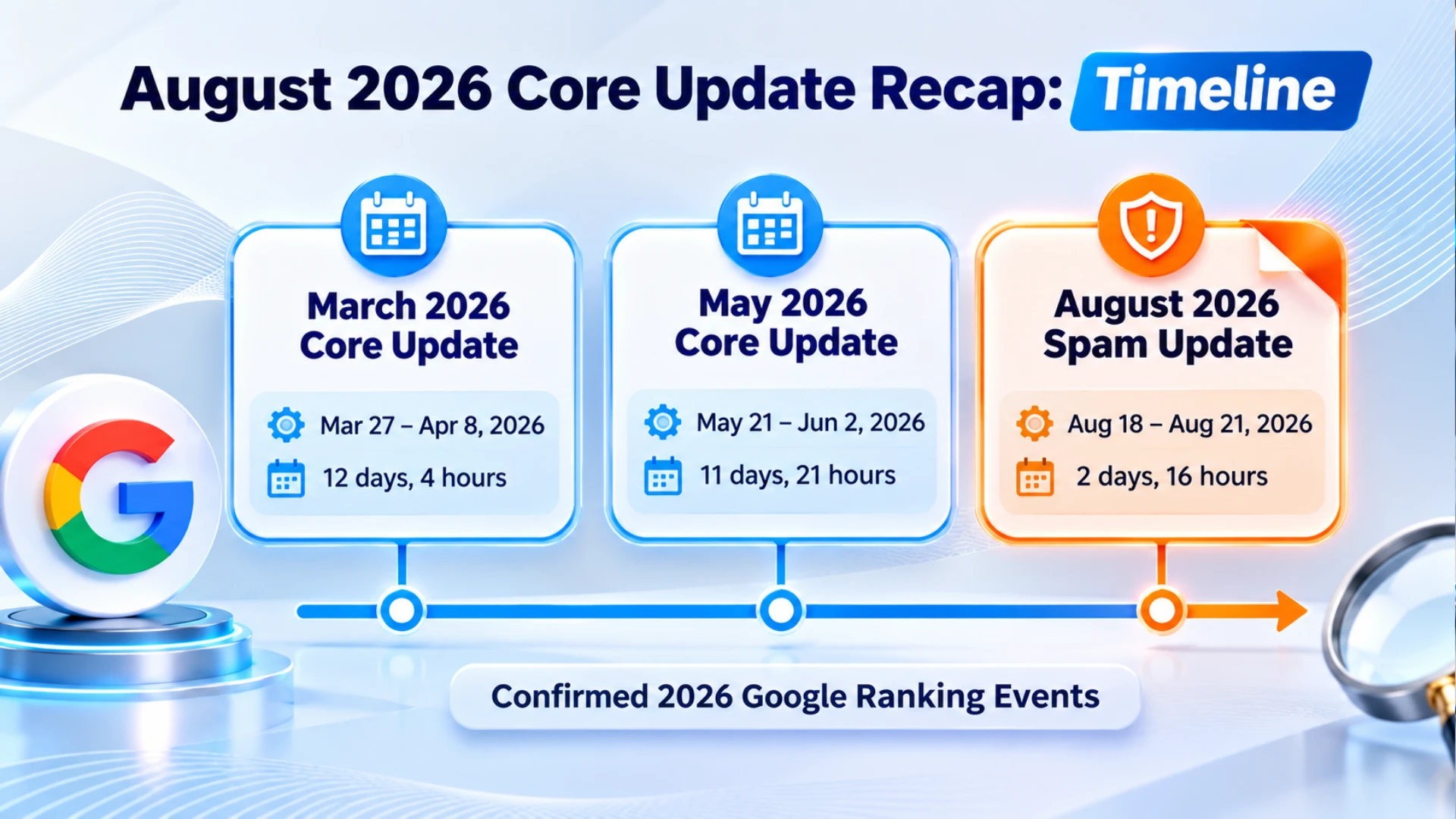
The August 2026 core update recap should be framed as a misnamed update recap. Google’s official record shows the August event was a spam update affecting ranking. It began at 2026-08-18 09:27 Pacific time, Google posted the release note at 09:28, and the rollout was complete on August 21, 2026 at 01:49 Pacific time. Google also stated that the update applied globally and to all languages.
Confirmed 2026 Google ranking events
| Event | Official date | Rollout length | What SEO teams should note |
|---|---|---|---|
| March 2026 core update | March 27, 2026 | 12 days, 4 hours | Broad ranking reassessment, not a page-specific penalty |
| May 2026 core update | May 21, 2026 | 11 days, 21 hours | Closest confirmed 2026 core update before August |
| August 2026 spam update | August 18, 2026 | 2 days, 16 hours | The confirmed August event; global and all languages |
Google’s dashboard lists the May 2026 core update as released on May 21 and complete on June 2, while the March 2026 core update started on March 27 and completed on April 8. That timing matters because a site owner comparing August traffic against “core update” expectations may use the wrong recovery checklist.
SEOPEZ starts any August 2026 core update recap with a data separation step: March and May are core-update analysis windows; August 18–21 is a spam-update analysis window. The difference changes what gets audited first.
Why the August Label Causes Confusion?
The phrase August 2026 core update recap is understandable because many site owners use “core update” as shorthand for any major Google ranking movement. That shortcut is risky. Google’s core update documentation says core updates are broad changes to ranking systems and do not target specific sites or pages.
Spam updates are different. Google says spam updates are notable improvements to its automated spam-detection systems, including SpamBrain, and sites affected should review Google’s spam policies. Google also says recovery from spam compliance changes may take months as automated systems learn that a site follows the rules.
That is why SEOPEZ treats the August 2026 core update recap as a correction-and-diagnosis exercise. The question is not “what did the core update punish?” The better question is: did visibility change during the August spam update, or did normal volatility, earlier core updates, technical issues, content decay, indexing problems, or AI-search shifts create the drop?
What the August 2026 Spam Update Means?
The confirmed August 2026 spam update was the third spam update reported in 2026, following March and June spam rollouts, according to Search Engine Journal’s summary of the official dashboard. Search Engine Journal also reported that Google did not publish a companion blog post or announce new spam-policy types with the August rollout.
For SEOPEZ, that means the August 2026 core update recap should not invent a new target. There is no official statement saying the update specifically targeted AI content, affiliates, programmatic pages, local sites, ecommerce pages, or any single vertical. The safest analysis is to compare the affected pages against existing spam policies, content usefulness, indexing health, and query-level performance.
A useful starting point is a ranking drop audit workflow. If a page dropped between August 18 and August 21, SEOPEZ checks whether the decline is isolated to specific pages, templates, directories, query groups, countries, or devices. That prevents one update label from hiding the real cause.
Search Console Should Lead the Recap
A responsible August 2026 core update recap must begin in Search Console, not in rank-tracker panic. Google’s core update documentation recommends confirming rollout timing, waiting at least a full week after completion before analysis, comparing the right date ranges, reviewing pages and queries, and analyzing search types separately.
For the August spam update, SEOPEZ applies the same discipline with a spam-update lens. The clean comparison window starts after August 21, 2026, because the rollout was complete then. Search Engine Journal also noted that post-August 21 Search Console data gives a cleaner read than data pulled while the rollout was active.
Use Search Console date comparison steps to segment August performance by query, page, search type, country, and device. Then mark pages that lost impressions separately from pages that lost clicks. A page losing clicks but keeping impressions may have a SERP presentation or intent issue; a page losing impressions may have a ranking, indexing, or relevance issue.
Core Update Logic Still Matters
Even though the August 2026 core update recap is not an official August core update story, core-update logic still matters. Google says core updates reassess content overall as the web changes, and a page moving down is not necessarily “bad”; it may simply be outranked by content that better satisfies the query.
That is where SEOPEZ avoids reactionary edits. Google specifically warns against “quick fix” changes and recommends sustainable improvements that make sense for users. Google also says deleting content is a last resort, mainly when content cannot be salvaged or was created primarily for search engines.
For an August 2026 core update recap, that means low-quality recovery tactics can make the situation worse. Rewriting every title, deleting whole folders, adding generic AI paragraphs, or changing internal links without a page-level diagnosis can blur the evidence. SEOPEZ instead uses ranking decline error patterns to separate fixable SEO mistakes from broader quality reassessment.
Content Quality Is the Recovery Center
Google’s core-update guidance recommends assessing whether a site delivers helpful, reliable, people-first content. It also advises taking a close look at impacted pages and comparing them against the pages that now perform better for the same searches.
SEOPEZ turns that into a content review. Each affected page is checked for original value, outdated claims, weak examples, missing author or brand context, thin answers, copied summaries, unclear structure, and mismatch between title promise and body substance.
The recovery work often starts with content improvement techniques, but the work should not be cosmetic. A page about a technical topic needs clearer steps, better evidence, cleaner examples, and more complete coverage. A page about a commercial topic needs stronger problem-solution fit, trust signals, service clarity, and internal support.
On-Page Signals Need a Full Review
An August 2026 core update recap should not ignore on-page basics. Title tags, meta descriptions, H1s, section headings, internal links, entity references, image alt text, and schema alignment all help Google and users understand the page.
SEOPEZ checks affected pages with a page-level optimization sequence before making larger strategic assumptions. If a page dropped after August 18, but the title no longer matches the live query intent, the intro is vague, and the page lacks internal links, the issue may be basic page relevance rather than update-specific damage.
Meta elements deserve special attention because click behavior can shift after ranking volatility. A page may keep visibility but lose clicks if the title or description no longer matches the searcher’s expectation. The metadata rewrite checklist helps align search snippets with the real page promise.
Technical Health Can Look Like Update Damage
Many sites blame Google updates for problems caused by crawl, rendering, speed, mobile usability, or indexing issues. An August 2026 core update recap should therefore include a technical section before any final conclusion.
SEOPEZ audits crawl paths, robots rules, canonical tags, redirects, pagination, XML sitemaps, JavaScript rendering, mobile templates, and server behavior. A ranking drop that begins near an update can still be caused by a deployment, CMS change, theme update, plugin conflict, or indexing mistake.
Use technical SEO fundamentals to identify problems that non-developers can understand. Then check indexing diagnostic steps for pages that lost impressions sharply, disappeared from queries, or changed canonical status.
Page Experience Still Supports Recovery
Google’s August 2026 spam update was not announced as a page-experience update. Still, page experience can influence user satisfaction, crawling efficiency, and conversion performance after visibility changes. SEOPEZ reviews Core Web Vitals, loading behavior, mobile usability, layout stability, and interaction delays as part of the broader recovery process.
SEOPEZ August review matrix
| Review area | What to check | Why it matters after August |
|---|---|---|
| Search Console data | Pages, queries, countries, devices, search types | Confirms whether the decline matches the update window |
| Spam exposure | Policy compliance, scaled content, abusive links, doorway patterns | Matches the confirmed August spam-update type |
| Content quality | Originality, depth, freshness, expertise, usefulness | Aligns with core-update quality logic |
| Technical SEO | Indexing, canonicals, redirects, crawlability, rendering | Prevents technical faults from being misread as update impact |
| Page experience | Speed, mobile usability, layout stability | Supports users after ranking and click shifts |
| Internal authority | Internal links, orphan pages, topic clusters | Helps affected pages regain contextual strength |
The Core Web Vitals field metrics and page speed ranking context help teams prioritize performance issues without pretending speed alone explains every August movement. The mobile search usability rules also matter because mobile presentation problems can reduce engagement even when rankings remain stable.
Internal Links Show Which Pages Matter
A useful August 2026 core update recap should include internal linking. Google’s older core-update guidance notes that links between pages are one of the signals Google uses to understand content, while also saying it uses many other signals.
SEOPEZ looks for orphan pages, weak hub pages, over-optimized anchors, unrelated internal links, and buried commercial pages. When important pages lack internal support, they may be harder to interpret within the site’s topic structure.
Use internal linking structure signals to connect supporting posts, service pages, and category pages. The aim is not to add random links. The aim is to show which pages explain the topic, which pages support the service, and which pages deserve crawl and ranking priority.
Off-Page Signals and Spam Risk Need Separation
The August 2026 core update recap should separate healthy authority signals from spam exposure. A site may lose visibility because low-value link tactics, syndicated pages, manipulative placements, or reputation-abuse patterns became easier for Google’s systems to discount.
Google’s spam-update documentation says sites affected by spam updates should review spam policies, and in the case of link spam updates, removed link value may not be regained because the previous benefit is lost.
SEOPEZ checks link patterns carefully. The goal is not to disavow everything after a traffic dip. The goal is to identify patterns that violate policies, reduce reliance on artificial signals, and strengthen legitimate authority. The off-page authority signal map helps keep that work grounded in sustainable brand and topic relevance.
Schema Helps Clarify, Not Rescue
Schema markup should be part of an August 2026 core update recap, but it should not be treated as a rescue switch. Structured data can clarify page meaning and improve eligibility for supported search features when it matches visible page content. It cannot make thin content helpful or make a spam-risk page trustworthy.
SEOPEZ checks whether schema is present, valid, relevant, and aligned with visible content. For service businesses, that may include Organization, LocalBusiness, Service, FAQ, Breadcrumb, or Review markup where appropriate and compliant. For publishers, Article and author-related markup may help clarify ownership and context.
The structured data implementation basics are useful here. In an August 2026 update review, schema should support the page’s real purpose. It should not be used to exaggerate ratings, hide claims, or mark up content that users cannot see.
New Websites Should Be Extra Careful
New websites often misread update movement because they lack stable baseline data. A new domain may fluctuate during August because of weak topical depth, limited crawl history, thin internal links, insufficient brand signals, or unstable indexing.
SEOPEZ treats new-site recovery differently. Instead of asking whether the August 2026 spam update “hit” the site, the first question is whether the site has enough quality signals to be evaluated consistently. That includes site architecture, page purpose, internal links, crawl paths, author or brand context, and content depth.
The new domain search foundation helps prevent overreaction. A young site should avoid scaling thin pages, duplicating service content, and publishing unsupported AI-generated summaries. Those habits create the same weaknesses that update windows tend to expose.
AI Search Adds Another Layer
An August 2026 core update recap for 2026 cannot ignore AI Search. Google’s ranking changes, AI Overviews, AI Mode, zero-click behavior, and citation patterns can all affect how organic visibility is experienced.
That does not mean every traffic drop is caused by AI. It means recovery reporting should include classic rankings, Search Console visibility, AI citation checks, no-click SERP exposure, and branded demand. The AI search visibility transition is relevant because user journeys are no longer limited to blue-link clicks.
The no-click search behavior model helps explain why impressions may remain while clicks soften. The AI source citation gap shows why ranking and citation visibility should be reviewed separately.
GEO and SEO Belong in the Same Recap

The August 2026 core update recap should connect traditional SEO with Generative Engine Optimization. GEO does not replace technical SEO, content quality, or crawlability. It adds a visibility layer where content must be easy for AI systems to understand, summarize, and cite.
SEOPEZ reviews whether affected pages are entity-clear, source-worthy, concise where needed, and supported by related internal resources. A strong page should explain the topic, show evidence, answer follow-up questions, and make the brand’s role clear without overclaiming.
The generative visibility foundation helps teams separate GEO from classic SEO without treating them as rivals. The SEO GEO AEO role framework is useful for deciding whether a page needs better ranking support, answer extraction, or generative-source clarity.
How SEOPEZ Handles the August Review
SEOPEZ handles an August 2026 core update recap in four stages. First, confirm whether the decline matches the official update window. Second, separate spam-risk issues from core-quality issues. Third, review technical, content, internal-link, and Search Console evidence. Fourth, build a prioritized recovery plan that avoids quick fixes.
For local and service-based businesses, SEOPEZ can also check website for seo optimization when ranking changes affect location pages, service pages, or map-adjacent organic visibility. The review focuses on page clarity, crawl health, local relevance, and conversion paths.
If your site moved around August 18–21, SEOPEZ will not label the drop blindly. The better path is to identify which pages moved, which queries changed, whether the movement fits the spam-update window, and whether deeper content or technical improvements are needed. A careful recap protects the site from rushed edits that create new problems.
SEOPEZ can turn the August 2026 core update recap into a practical recovery roadmap. Through seo optimization strategies, the team reviews Search Console data, page quality, technical barriers, spam-risk signals, internal linking, and AI-search visibility. The goal is not to chase an update name. The goal is to make the site clearer, cleaner, and more useful for the searches that still matter.
FAQs About the August 2026 Core Update Recap
Was there an official August 2026 core update?
No official Google record currently lists an August 2026 core update. Google’s Search Status Dashboard lists the confirmed August ranking event as the August 2026 spam update, which began on August 18 and completed on August 21. The dashboard lists confirmed 2026 core updates in March and May, not August.
Why are people calling it the August 2026 core update?
People often call major ranking movement a core update because “core update” has become a general SEO phrase. For accuracy, this August 2026 core update recap should call the confirmed event a spam update. That distinction matters because core updates broadly reassess helpful and reliable content, while spam updates improve Google’s spam-detection systems.
What dates should I use for August 2026 analysis?
Use August 18–21, 2026 as the confirmed rollout window for the August spam update. For cleaner analysis, compare performance after the rollout completed with a stable period before August 18. Google’s core-update guidance recommends waiting at least a full week after a core rollout ends before analysis; the same patience helps avoid noisy conclusions after the August spam rollout.
What should I check first after an August ranking drop?
Start with Search Console. Review pages, queries, countries, devices, and search types. Then check whether the drop matches the August 18–21 window. If it does, review spam-policy risk, content quality, indexing, technical SEO, and internal links. Do not rewrite or delete pages before identifying whether the issue is visibility, clicks, indexing, relevance, or compliance.
Can a site recover from the August 2026 spam update?
Recovery is possible when the underlying issue can be improved, but it may not be immediate. Google says sites affected by spam updates should review spam policies, and improvements may take months as automated systems learn that a site complies. For link spam, lost artificial link value may not return because the ranking benefit has been removed.
Should I delete pages after the August 2026 update window?
Deletion should be a last resort. Google’s core-update guidance says site owners should avoid quick fixes and focus on sustainable improvements. It also says deleting content is only worth considering when the content cannot be salvaged or when whole sections were created for search engines rather than people. A better first step is a page-by-page quality and intent review.
How does AI Search affect this August 2026 recap?
AI Search affects the recap because traffic changes can come from more than ranking movement. AI Overviews, AI Mode, no-click results, and citation behavior can change how users interact with results. That is why SEOPEZ reviews rankings, impressions, clicks, AI-source visibility, branded demand, and conversions together instead of treating sessions as the only signal.
Want us to handle it for you?
See the sites, the numbers and the price before you order.