

AI query fan-out works by breaking a complex user question into multiple related search paths, retrieving relevant information from different sources, and combining the findings into a generated answer. For SEO, this means creating helpful, well-structured content that addresses genuine search intent, provides credible evidence, and remains accessible to search engines.
AI search has made a familiar SEO problem harder: one visible question may trigger several unseen searches before an answer appears. Teams that chase imagined query lists can create bloated pages, duplicate articles, and unsupported claims. The serious response is to understand the retrieval architecture, validate likely intent dimensions, and build focused evidence around the user’s real decision.
Experienced SEO work treats fan-out as a dynamic research process rather than a keyword-stuffing formula. The goal is not to predict every hidden search because platforms do not expose a permanent list. The goal is to make the right page technically eligible, genuinely useful, well connected, and strong enough to support a trustworthy answer.
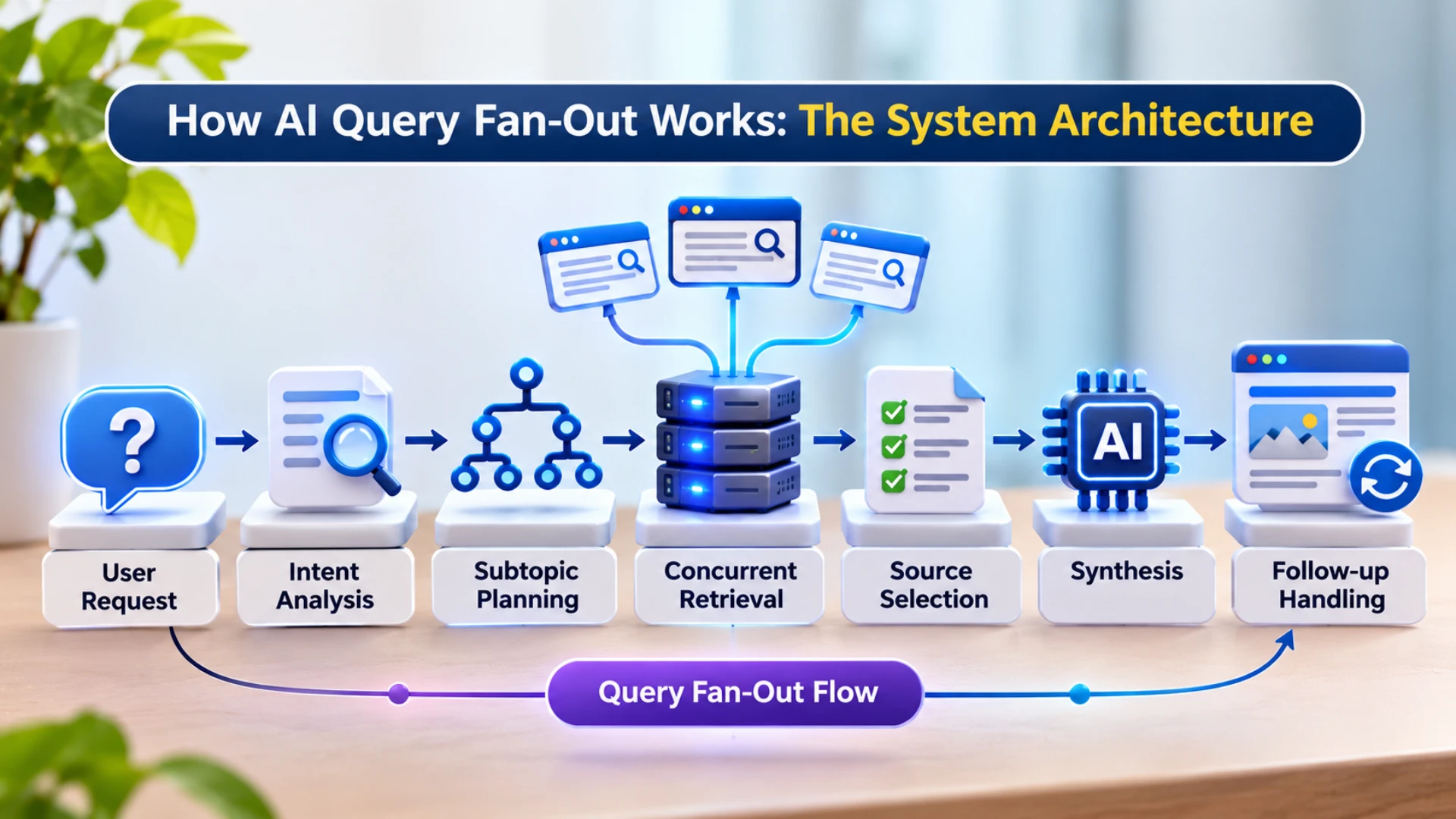
Query fan-out expands a complex request into connected search paths. Each path investigates a necessary part of the original intent. The retrieved evidence is then assessed and assembled into a useful response.
| Architecture stage | What the system does | SEO meaning |
|---|---|---|
| 1. User request | Receives a question, comparison, task, or follow-up | The visible wording is only the starting point |
| 2. Intent analysis | Identifies the goal, constraints, entities, and missing details | One topic may contain several decision factors |
| 3. Subtopic planning | Creates related search paths around those factors | Paths can change with context and phrasing |
| 4. Concurrent retrieval | Runs multiple related searches across relevant sources | Google publishes no fixed query count |
| 5. Source selection | Finds pages or data supporting parts of the answer | Technical eligibility and relevance still matter |
| 6. Synthesis | Combines selected information into a response with links | A page can support one important answer component |
| 7. Follow-up handling | Reassesses intent after another question | A follow-up can begin a new retrieval cycle |
The step-by-step architecture begins with interpretation, not keyword expansion. The system considers what the user wants to accomplish, which entities are involved, and which details must be resolved. Similar wording can therefore produce different search paths when the context or desired action changes.
The model then creates related searches covering definitions, comparisons, limitations, current facts, local information, or supporting evidence. Retrieval connects those searches with indexed pages and relevant data sources. Selected information is finally synthesized into a direct response with links that help the user investigate further.
Fan-out can improve breadth, but it does not guarantee perfect accuracy or remove hallucinations. The number of searches, pages considered, ranking methods, and source-selection steps are not published as one fixed formula. SEOs should explain the confirmed process without inventing precise internal mechanics.
Why One Prompt Splits Into Multiple Search Paths?
A complex prompt usually contains more than one information need. The system separates those needs so it can investigate them efficiently. This produces broader evidence than one traditional keyword search may provide.
A request about accounting software for a five-location retailer may require pricing, integrations, permissions, reporting, training, and alternative comparisons. Those factors support one purchase decision, so several related searches can contribute to one response. A different user asking only for a definition may trigger a narrower process.
Fan-out is contextual rather than permanent. Wording, location, current information, conversation history, named entities, and desired action can influence the search paths. Marketers should therefore treat generated query lists as hypotheses rather than hidden Google data.
A disciplined keyword research process combines SERPs, customer questions, support records, reviews, competitor gaps, and first-party knowledge. Closely related factors can remain together when they complete one decision. Different audiences, locations, problems, or buying stages may need separate pages.
Concrete Example: Fan-Out in Action for SEO Teams
A practical example makes the retrieval process easier to understand. The scenario below shows likely search dimensions without claiming they are Google’s actual hidden queries. It also demonstrates how page scope should follow intent.
Imagine a business owner asks: “How can a three-location dental group improve local visibility without creating duplicate pages?” The system may investigate local result structure, Business Profiles, location-page differentiation, reviews, technical access, and measurement. Every dimension supports the same growth decision.
| Likely intent dimension | Supporting issue | Best content response |
|---|---|---|
| Local visibility | Map and organic signals | Explain listings, pages, relevance, and authority |
| Business Profiles | Location-specific optimization | Give setup and maintenance steps |
| Location pages | Avoiding duplication | Use distinct services, proof, staff, and local context |
| Reviews | Trust and issue handling | Explain acquisition and response practices |
| Technical access | Crawl and index eligibility | Check canonicals, links, rendering, mobile use, and speed |
| Measurement | Progress and business value | Track visibility, engagement, calls, and bookings |
The visibility path could use a local organic results overview and an explanation of organic local ranking factors. The profile path should lead to specific business profile optimization steps, not a vague instruction to complete every field. The trust path should explain the review response importance for customers and reputation management.
The page-architecture path needs a controlled location page creation workflow rather than copied city-name replacements. Broader local SEO improvement methods can connect profiles, local pages, reviews, links, and proof. The example remains a planning model, not proof that Google issued those exact searches.
How Sources Get Retrieved, Selected, and Synthesized?
Fan-out creates search paths, but retrieval determines whether useful evidence is available. A page must be discoverable, relevant, and eligible before it can support an AI response. Strong writing cannot compensate for blocked or inaccessible content.
Google’s generative search features retrieve pages through the Search index and established ranking systems. This makes technical SEO basics directly relevant to AI visibility. Crawl access, indexability, canonical signals, internal discovery, and visible text remain foundational.
A structured SEO audit structure should check robots directives, noindex tags, canonicals, duplicate URLs, orphan pages, JavaScript rendering, and broken paths. It should also confirm that the page can appear with a normal Search snippet. These checks determine whether content can enter the retrieval pool.
Page experience matters after a supporting link earns attention. A core web performance explanation, mobile SEO planning guide, and review of page speed ranking impact can turn technical findings into prioritized action. Selection remains dynamic, so the safest strategy is accurate information with clear relevance and credible evidence.
Core Technical Benefits Without Common Fan-Out Myths
Fan-out helps a search system explore nuanced requests. It can widen retrieval, compare evidence, and find specialized supporting pages. Those benefits should not become unsupported promises or fixed operating rules.
The main benefits are broader intent coverage, access to specialized evidence, and more opportunities for focused pages to contribute. One source may explain a process, another may provide current data, and another may document limitations. A page can support one valuable answer component without covering the entire topic.
Strong content optimization techniques should improve clarity, evidence, and usefulness rather than force every possible phrase into the copy. Google publishes no universal subquery count, guaranteed page count, special fan-out schema, or ideal article length. A clear schema markup meaning remains useful for normal Search features but does not guarantee AI selection.
Formatting is not a shortcut either. Tables, steps, highlighted answers, and FAQs help when they match the information and support readers. Use the on-page SEO checklist guide as quality control, not as a formula for manipulating generative results.
Build Better Content Around Intent, Not Hidden Queries
The strongest fan-out strategy starts with human decisions and credible evidence. It does not begin with hundreds of synthetic phrases. Page architecture should reflect where user goals remain connected and where they materially change.
Define one primary outcome, then list only the factors required to reach it. Keep price, reliability, compatibility, and maintenance together when they support one comparison. Separate pages when the audience, location, problem, product category, outcome, or buying stage changes.
A clear explanation of internal linking impact shows why related pages should connect around genuine next questions. Links should guide exploration, distribute discovery signals, and clarify relationships. They should not repeat imagined fan-out phrases mechanically.
Every page also needs a defensible position where customer demand, business capability, and credible evidence overlap. Avoid common SEO ranking mistakes such as copying competitor summaries or claiming strengths the business cannot prove. Distinctive examples, documented processes, limitations, and first-hand experience make content harder to replace.
External confirmation can support important claims. A thoughtful off-page SEO strategy overview may include genuine reviews, expert references, partnerships, and community participation. For local organizations, the local event sponsorship value should come from real involvement rather than manufactured mentions.
Measure AI Visibility Without Inventing Query Data
Measurement must separate observable performance from hidden system activity. Search platforms expose outcomes, not every internal retrieval step. Responsible reporting makes that limitation clear from the beginning.
Search Console can show generative AI impressions and pages for eligible properties, with dimensions such as country, device, and date. It does not provide a complete export of every background fan-out search. A follow-up can also be recorded as a new user query.
Track AI-feature impressions, organic impressions, clicks, engaged sessions, branded demand, qualified leads, assisted conversions, and pages receiving generative exposure. These signals show whether discovery creates business value. Synthetic lists cannot prove which searches ran, which pages were retrieved, or why a source appeared.
Grounding metadata from a developer’s Gemini API request applies to that API interaction, not public AI Mode reporting. Applying accurate metadata optimization steps can still improve how listings communicate relevance. Metadata should describe the page honestly rather than promise guaranteed AI citations.
Turn Fan-Out Research Into a Repeatable SEO System

Fan-out becomes useful when it improves research, architecture, evidence, and execution. This workflow converts uncertainty into reviewable decisions. Each step produces an asset that can be measured and improved.
- Define the user decision. State the exact outcome and intended next action.
- Map necessary intent dimensions. Include only factors required to complete that decision.
- Validate every dimension. Use SERPs, customer language, reviews, support records, internal data, and competitor coverage.
- Choose the page structure. Keep connected factors together and separate materially different intents.
- Document proof. Add original examples, process details, comparisons, limitations, and business evidence.
- Confirm technical eligibility. Check crawling, indexing, canonicals, internal links, rendering, mobile use, and speed.
- Publish clear next steps. Use direct answers, descriptive headings, useful tables, and contextual links.
- Measure business value. Review visibility, engagement, qualified actions, and assisted revenue.
Organizations needing coordinated audits, content, technical fixes, internal linking, and reporting can use our all in one powerful monthly seo packages to turn this workflow into a managed program. The work should connect priorities to outcomes rather than produce disconnected tasks. It is most useful when several weaknesses must be corrected in the right order.
Location-focused businesses can apply the framework through our affordable local seo solution. The service can align Business Profiles, location pages, reviews, technical access, and local authority around real customer decisions. This creates a clearer path from local discovery to calls, visits, and qualified enquiries.
Frequently Asked Questions About AI Query Fan-Out
These questions address the uncertainties SEO teams face most often. They focus on architecture, optimization, and measurement rather than repeating earlier sections. Each answer separates confirmed principles from assumptions.
Does every AI search trigger query fan-out?
No fixed rule says every request must trigger the same process. Simple questions may require less retrieval, while complex comparisons may require more investigation. Behavior can vary by product, model, context, and confidence.
How many subqueries does Google generate?
Google does not publish one universal number for ordinary AI Mode or AI Overviews. It describes multiple related searches, while the more intensive Deep Search mode can issue hundreds. Do not present an “8–15 query” range as fact.
Can SEOs discover Google’s exact fan-out queries?
Website owners cannot reliably obtain a complete hidden chain from standard Search Console reports. Visible queries and page impressions do not reconstruct every background retrieval action. Validate likely subtopics through search and customer evidence instead.
Are ChatGPT-generated fan-out terms useful?
They can help brainstorm constraints, comparisons, entities, and objections. They are not proof of Google’s actual searches or source choices. Keep only ideas supported by SERPs, audience language, first-party data, or credible evidence.
Should every related subtopic appear on one page?
No, because topical similarity does not always mean identical intent. Keep factors together when they support the same decision. Separate pages when audience, location, problem, outcome, or buying stage changes.
Does query fan-out require special schema?
No special query-fan-out markup is required for Google Search. Structured data should still match visible content and support standard features where appropriate. It does not guarantee inclusion in AI Mode or AI Overviews.
Can a noindex page support an AI Mode link?
A supporting page generally needs to be indexed and eligible to appear with a Search snippet. Blocking indexing removes that normal eligibility path. Confirm indexability before diagnosing content quality.
What should teams update after publishing?
Update content when facts, products, laws, prices, examples, customer needs, or business capabilities change. Do not refresh dates merely to simulate freshness. Review performance and new evidence before deciding what needs improvement.
Final Takeaway: Optimize Decisions, Not Query Lists
AI query fan-out is a retrieval architecture, not a new keyword formula. It breaks complex requests into related searches, retrieves supporting information, and synthesizes a response. The exact paths remain contextual, dynamic, and only partly observable.
The strongest SEO response is disciplined: understand the decision, publish distinctive evidence, separate different intents, connect useful pages, and maintain technical eligibility. Fan-out research should improve scope and proof rather than multiply thin pages. Success is useful visibility that leads to engagement, trust, and qualified business outcomes.
Want us to handle it for you?
See the sites, the numbers and the price before you order.