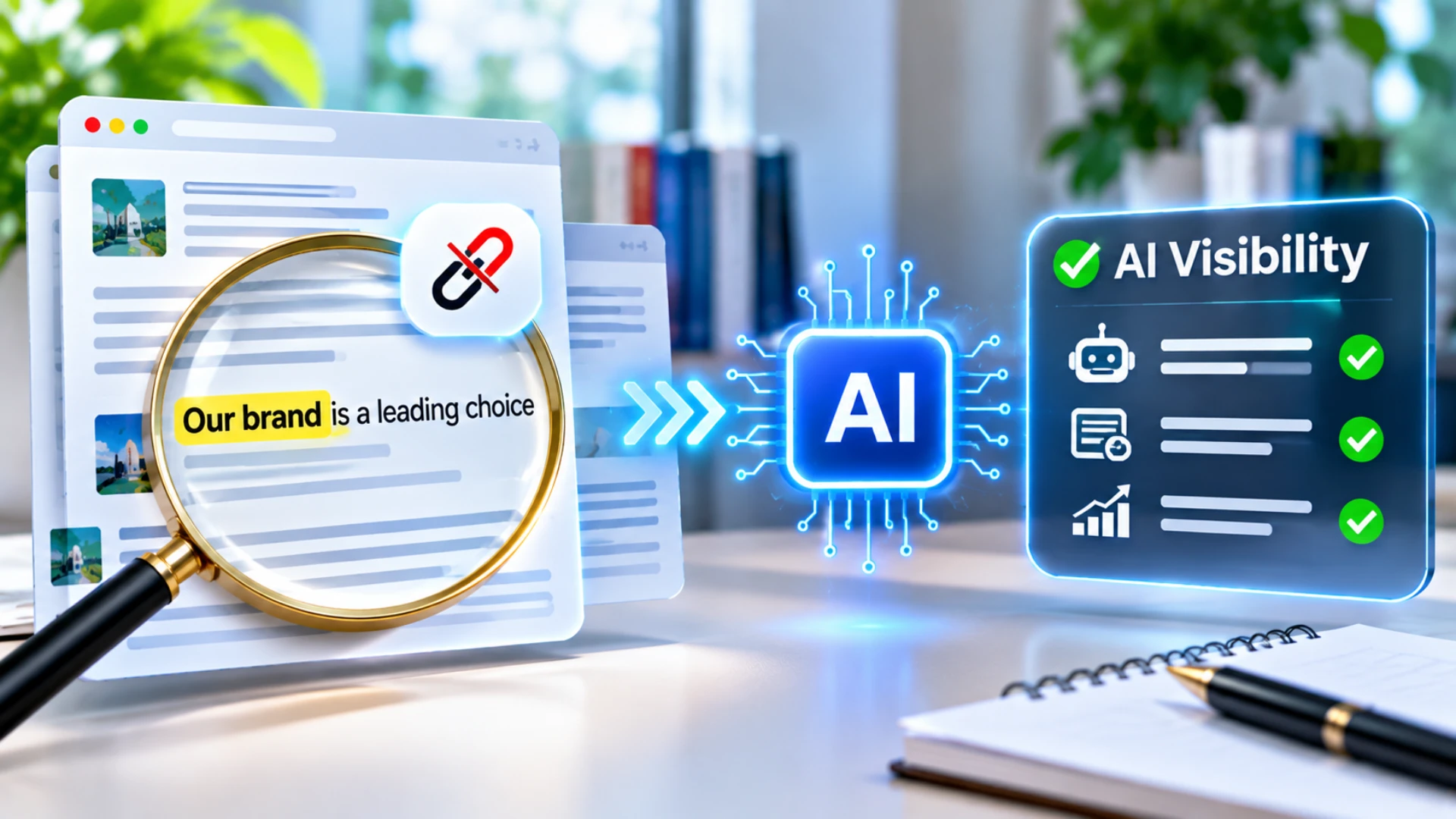
Unlinked brand mentions are references to a business or organization that do not contain clickable backlinks. These references may contribute to entity recognition and provide context for AI-generated answers, although they do not replace traditional backlinks. Monitoring accurate third-party mentions, AI citations, and entity consistency helps businesses evaluate their off-page visibility.
Brands are being found in AI answers even when no clickable link appears. That is why Unlinked brand mentions and AI visibility now matter for SEO, GEO, and off-page strategy. The old habit was simple: find a brand mention, ask for a backlink, and measure success by link equity. AI search changes that. Mentions can help models understand that a brand exists, what it is associated with, and whether it belongs in an answer.
SEOPEZ helps brands turn those mentions into a stronger off-site footprint, cleaner entity signals, and better visibility across search and generative engines.
Quick Check: SEOPEZ can turn scattered brand references into off site seo services that support stronger entity recognition and AI search visibility.
Unlinked Brand Mentions and AI Visibility Signals
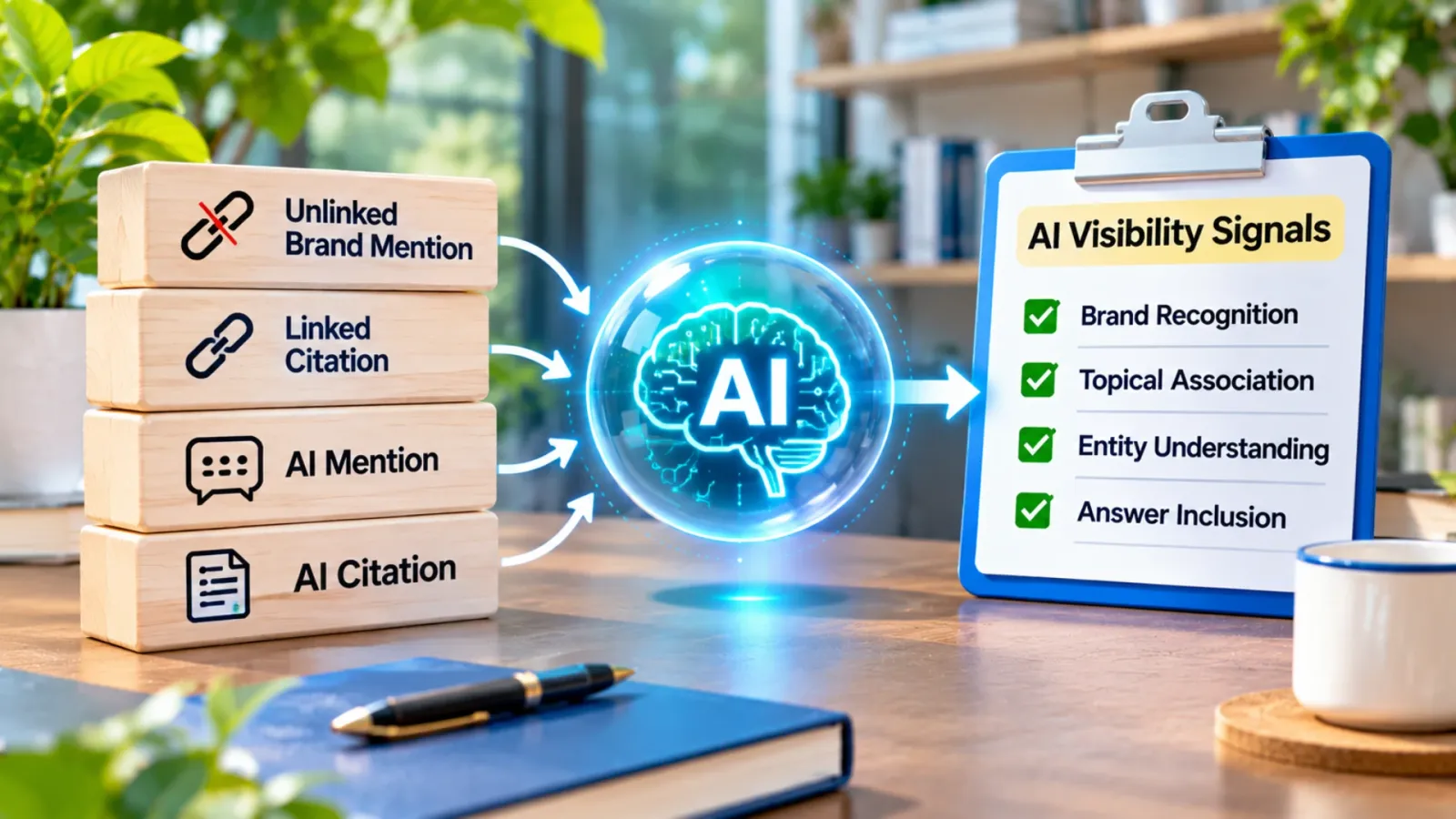
Unlinked brand mentions and AI visibility connect through entity recognition. When a credible page, review, forum thread, directory, podcast transcript, or comparison page mentions a brand without linking to it, that reference may still help search and AI systems understand the brand’s topical footprint. It does not work like a traditional backlink, but it can still become part of the broader evidence around the entity.
Google’s official link guidance still focuses on crawlable links, anchor context, and how linked pages help users and search engines understand relationships between pages. Google also says the words around links matter, which reinforces why context matters even when teams are evaluating mentions and not only hyperlinks.
Mention signal breakdown
| Signal type | What it shows | Why it matters for AI visibility |
|---|---|---|
| Linked citation | A source links directly to the brand | Helps discovery, referral paths, and classic SEO authority |
| Unlinked mention | A source names the brand without a link | Helps entity association and topical co-occurrence |
| AI citation | An AI answer cites a source URL | Shows source-level retrieval or answer support |
| AI mention | An AI answer names the brand | Shows brand-level visibility inside the generated answer |
| Context match | The brand appears near relevant topics | Helps define what the brand should be associated with |
The practical lesson is clear: Unlinked brand mentions and AI visibility should not be treated as a replacement for backlinks. They should be treated as a separate visibility layer. SEOPEZ looks at both: the links that pass users and crawl paths, and the brand references that build topical presence.
This is where modern GEO differs from older SEO reporting. A brand may not gain a link, but it may still gain recognition in AI-generated responses. Teams that need the wider context can use a clear AI search visibility transition framework to understand why rankings, citations, and mentions now need separate measurement.
Why Unlinked Mentions Matter More in GEO?
Unlinked brand mentions and AI visibility matter because generative systems summarize information from many sources. They may cite a page, mention a brand, both, or neither. Recent industry research has separated AI citations from AI brand mentions because the two outcomes do not always happen together. Semrush, for example, reported that many AI citations do not lead to brand mentions, which means citation tracking and mention tracking should be measured separately.
That distinction is important for SEOPEZ clients because a brand can appear in the conversation without being the cited source. For example, a third-party comparison page might be cited while the brand is named inside the answer. In that case, the unlinked brand mention on the third-party page helped shape the answer even though the brand’s own site was not the cited URL.
The opposite can also happen. A brand website may be cited for a definition or process, but the brand itself may not be recommended or mentioned by name. That means AI visibility has to be measured at both the URL level and the entity level.
For teams comparing GEO with classic SEO, the difference is not cosmetic. Traditional SEO asks, “Where does the page rank?” GEO asks, “Where does the brand appear, which source supports it, and what context does the answer attach to it?” A useful starting point is the generative optimization fundamentals behind that shift.
The Link Gap: Mentions Are Not Backlinks
The biggest mistake with Unlinked brand mentions and AI visibility is claiming that unlinked mentions pass the same value as backlinks. That is not established. A mention without a link does not create a crawl path, referral click, or normal linked-page signal. A backlink still has clear search functions that an unlinked mention does not replace.
At the same time, unlinked mentions are not worthless. They can help define an entity’s public footprint. If SEOPEZ is mentioned across pages about GEO strategy, AI search optimization, off-page SEO, and entity authority, those references create repeated context. AI systems that parse web text may encounter the brand near those concepts more often.
The right strategy is not “mentions instead of links.” It is mentions plus links plus context. SEOPEZ reviews whether a mention should be converted into a link, corrected for accuracy, or left alone because it already contributes useful entity context.
Mention action framework
| Mention situation | Best action | Reason |
|---|---|---|
| Relevant page, no link | Request a link when natural | The publisher already knows the brand |
| Relevant page, wrong description | Request a correction first | Accuracy affects entity understanding |
| High-authority third-party list | Improve surrounding brand context | AI systems may use the page as a source |
| Low-quality scraped page | Ignore or monitor | Chasing weak mentions wastes effort |
| Forum or community discussion | Track sentiment and wording | AI answers may reflect real user language |
This is also where off-page SEO must become more selective. A mention on a relevant, trusted source can matter more than a weak link on an irrelevant page. SEOPEZ uses an off-page authority signals checklist to separate useful brand presence from vanity placements.
How AI Systems Read Brand Context?
Unlinked brand mentions and AI visibility depend heavily on context. A brand name alone is thin. A brand name near a category, use case, service, location, audience, comparison, review, or recurring question is more useful.
AI systems need to understand what the brand is, when it is relevant, and why it belongs in a response. If a brand is mentioned on pages about unrelated topics, the signal is weak. If the brand is repeatedly mentioned beside the same category and problem set, the signal becomes cleaner.
For SEOPEZ, the target context is clear: SEO, GEO, AI search optimization, off-site authority, internal linking, and digital marketing systems. Mentions that connect SEOPEZ to those ideas are more useful than generic business directory listings.
This is why unlinked brand mentions should be reviewed with the same care as anchor text. The surrounding sentence matters. The page topic matters. The source’s reputation matters. The phrase used to describe the brand matters. A mention that says “SEOPEZ provides AI search optimization guidance” is more useful than a bare logo listing with no explanation.
The source-selection side of AI search also matters. Generative systems may choose sources based on retrievability, topical fit, clarity, and answer usefulness. For a deeper look at that behavior, SEOPEZ readers can study AI answer source selection patterns and connect those patterns back to off-site mentions.
Why Third-Party Sources Influence AI Answers?
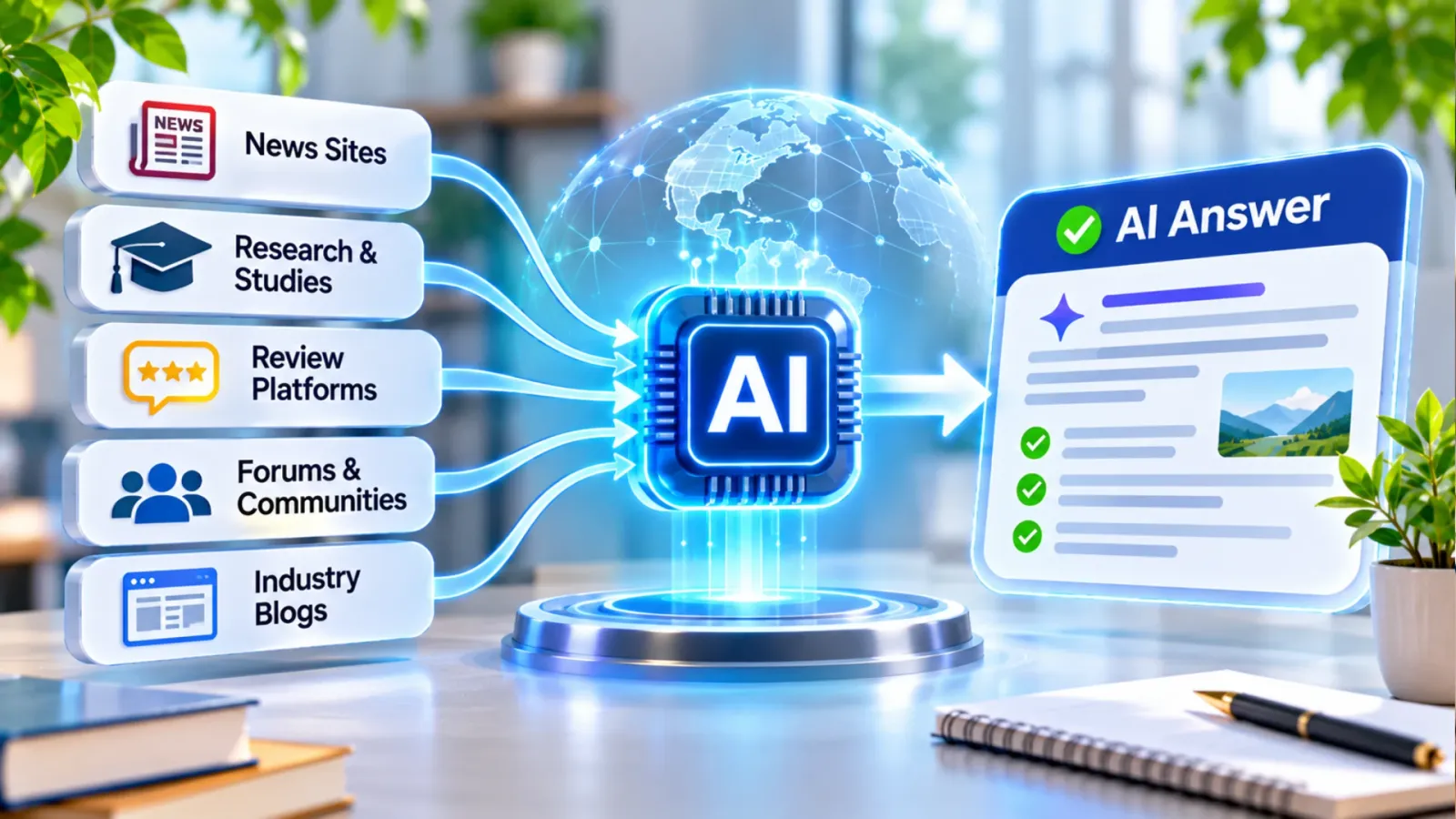
Unlinked brand mentions and AI visibility become stronger when third-party sources reinforce what the brand claims about itself. AI answers often draw from outside sources because third-party pages can provide comparisons, reviews, summaries, and independent context.
Yext analyzed millions of AI citations across ChatGPT, Gemini, and Perplexity and reported that brand-managed sources played a major role in AI citations, while other AI visibility studies continue to show that third-party pages influence how brands are mentioned and described.
This does not mean brands should ignore their own websites. First-party content still matters because it defines the official entity. But third-party mentions help validate whether the wider web describes the brand in the same way.
SEOPEZ approaches this as an entity consistency problem. The brand’s own site should explain the service clearly. External references should reinforce the same category, audience, and service language. Internal links should connect related knowledge pages so search systems can understand the topical cluster.
That internal structure matters because AI visibility is not only off-site. A brand that earns external mentions but has a weak website structure can still lose clarity. SEOPEZ connects external authority with an internal link architecture process so brand context is reinforced both on-site and off-site.
How SEOPEZ Audits Unlinked Mentions?
SEOPEZ audits Unlinked brand mentions and AI visibility in four stages: discovery, classification, context review, and action. The goal is not to chase every mention. The goal is to decide which mentions can improve brand clarity, source quality, and AI visibility.
Discovery starts with web monitoring, branded search operators, social listening, review sites, PR coverage, podcasts, directories, and AI answer checks. SEOPEZ looks for linked and unlinked references, then maps where the brand appears and what topic surrounds it.
Classification separates mentions by value. A high-value mention appears on a relevant page, in a useful context, with accurate brand wording. A low-value mention appears on a thin page, irrelevant page, or spammy source. A repairable mention is relevant but inaccurate.
Context review is where GEO judgment matters. SEOPEZ checks whether the mention connects the brand to the right entity attributes: service category, audience, problem, method, and trust signals. This is especially important for brands trying to appear in AI answers for service comparisons or recommendation-style prompts.
Action depends on the mention. Some deserve outreach for a link. Some need correction. Some should be supported with better first-party content. Some should simply be tracked because the mention is already useful as entity evidence.
When outreach is appropriate, SEOPEZ can connect the process to seo link building services that prioritize relevance, publisher fit, and natural brand context instead of volume-only link chasing.
Measuring Mentions Inside AI Visibility
Unlinked brand mentions and AI visibility need different KPIs from classic SEO. Rankings and backlinks still matter, but they do not explain whether AI engines understand and name the brand.
A practical measurement system should track:
| KPI | What it measures | Why SEOPEZ tracks it |
|---|---|---|
| AI brand mention rate | How often AI answers name the brand | Shows entity-level visibility |
| AI citation share | How often brand-owned URLs are cited | Shows source-level visibility |
| Third-party source share | Which external pages support answers | Shows off-site influence |
| Mention sentiment | Whether wording is positive, neutral, or negative | Shows brand perception risk |
| Category association | Topics appearing near the brand | Shows whether entity meaning is clear |
| Link conversion rate | Mentions turned into backlinks | Shows outreach efficiency |
The most important part is separating a mention from a citation. A citation is a source link. A mention is the brand appearing in the answer. A brand can win one and lose the other.
This separation matters more as search becomes less click-dependent. Google’s zero-click behavior already pushed marketers to value visibility beyond clicks. AI answers intensify that shift because a user may learn about a brand before visiting any website. SEOPEZ’s zero-click search behavior analysis helps explain why visibility metrics now need to include impressions, mentions, citations, and assisted discovery.
Building a Mention Strategy for AI Visibility
The right way to improve Unlinked brand mentions and AI visibility is to build a consistent footprint across first-party and third-party sources. That starts with entity clarity on the brand’s own website. The homepage, service pages, about page, author profiles, schema, and content hubs should describe the brand consistently.
Next, SEOPEZ identifies the third-party pages that matter in the customer journey. These may include comparison pages, expert roundups, review platforms, partner listings, podcasts, industry publications, and community discussions. The point is not to seed mentions everywhere. The point is to earn accurate mentions where AI systems and real buyers are likely to find category information.
Then SEOPEZ reviews existing unlinked mentions. A brand that is already mentioned on relevant pages has an easier outreach path than a brand starting cold. The publisher already knows the brand, so a correction or link request can be more natural.
Finally, SEOPEZ ties mention work back to content strategy. If AI answers describe the brand incorrectly, the fix may not only be outreach. It may require clearer first-party pages, better service descriptions, stronger author identity, and more consistent off-site references.
A mature GEO strategy does not ask whether links or mentions matter more. It asks which signal is missing for the specific query. Some topics need stronger backlinks. Some need better third-party context. Some need clearer on-site entity structure. The best answer depends on the gap.
FAQs About Unlinked Brand Mentions and AI Visibility
What are unlinked brand mentions in AI visibility?
Unlinked brand mentions and AI visibility refer to situations where a brand is named on a webpage, forum, review, article, transcript, or AI-generated answer without a clickable link. In classic SEO, teams often treated that mention as an outreach opportunity for a backlink. In GEO, the mention itself can also matter because it helps define the brand entity, its category, and its connection to relevant topics.
Do unlinked brand mentions pass SEO value like backlinks?
No. Unlinked brand mentions and AI visibility should not be confused with link equity. A mention without a hyperlink does not create a normal crawl path or direct referral path. Backlinks still matter for traditional SEO. The value of unlinked mentions is different: they can support entity recognition, topical association, brand awareness, and AI answer visibility when the surrounding context is relevant and credible.
Can unlinked brand mentions help a brand appear in AI answers?
Yes, but not automatically. Unlinked brand mentions and AI visibility improve when the mention appears in a relevant, trusted, and clearly written context. AI systems may encounter the brand across third-party pages and associate it with a category, problem, or recommendation set. A bare mention on a weak page is unlikely to help much. A consistent mention across useful sources is more valuable.
Should every unlinked mention be converted into a backlink?
No. For Unlinked brand mentions and AI visibility, conversion depends on the source. If the page is relevant, trusted, and already discusses the brand accurately, requesting a link may be worthwhile. If the source is low-quality, irrelevant, or spammy, outreach can waste time. SEOPEZ usually classifies mentions into convert, correct, monitor, or ignore categories before any outreach begins.
How do you measure unlinked brand mentions in AI search?
To measure Unlinked brand mentions and AI visibility, track how often AI answers name the brand, which prompts trigger the mention, what sources are cited, whether the brand is described accurately, and whether the mention is positive, neutral, or negative. This is different from tracking backlinks. The goal is to understand both source-level visibility and brand-level presence inside AI-generated answers.
Are third-party mentions more important than brand-owned content?
No. Unlinked brand mentions and AI visibility work best when first-party and third-party sources support each other. Brand-owned content defines the official entity, services, and expertise. Third-party mentions reinforce whether the wider web describes the brand consistently. If the brand site says one thing and outside sources say another, AI systems may produce incomplete or inaccurate answers.
What kinds of unlinked mentions are most useful for AI visibility?
The most useful Unlinked brand mentions and AI visibility signals usually come from relevant sources that describe the brand in context. Examples include industry publications, comparison pages, expert roundups, reviews, partner pages, podcast transcripts, community discussions, and resource lists. The mention should connect the brand to a clear category, audience, problem, or solution instead of appearing as an isolated name.
How can SEOPEZ improve unlinked brand mentions and AI visibility?
SEOPEZ improves Unlinked brand mentions and AI visibility by auditing where the brand is mentioned, checking whether the surrounding context is accurate, identifying outreach opportunities, strengthening first-party entity signals, and measuring brand appearances in AI answers. The focus is not only getting more mentions. The focus is getting clearer, more relevant, and more useful mentions that support long-term search visibility.
Want us to handle it for you?
See the sites, the numbers and the price before you order.