
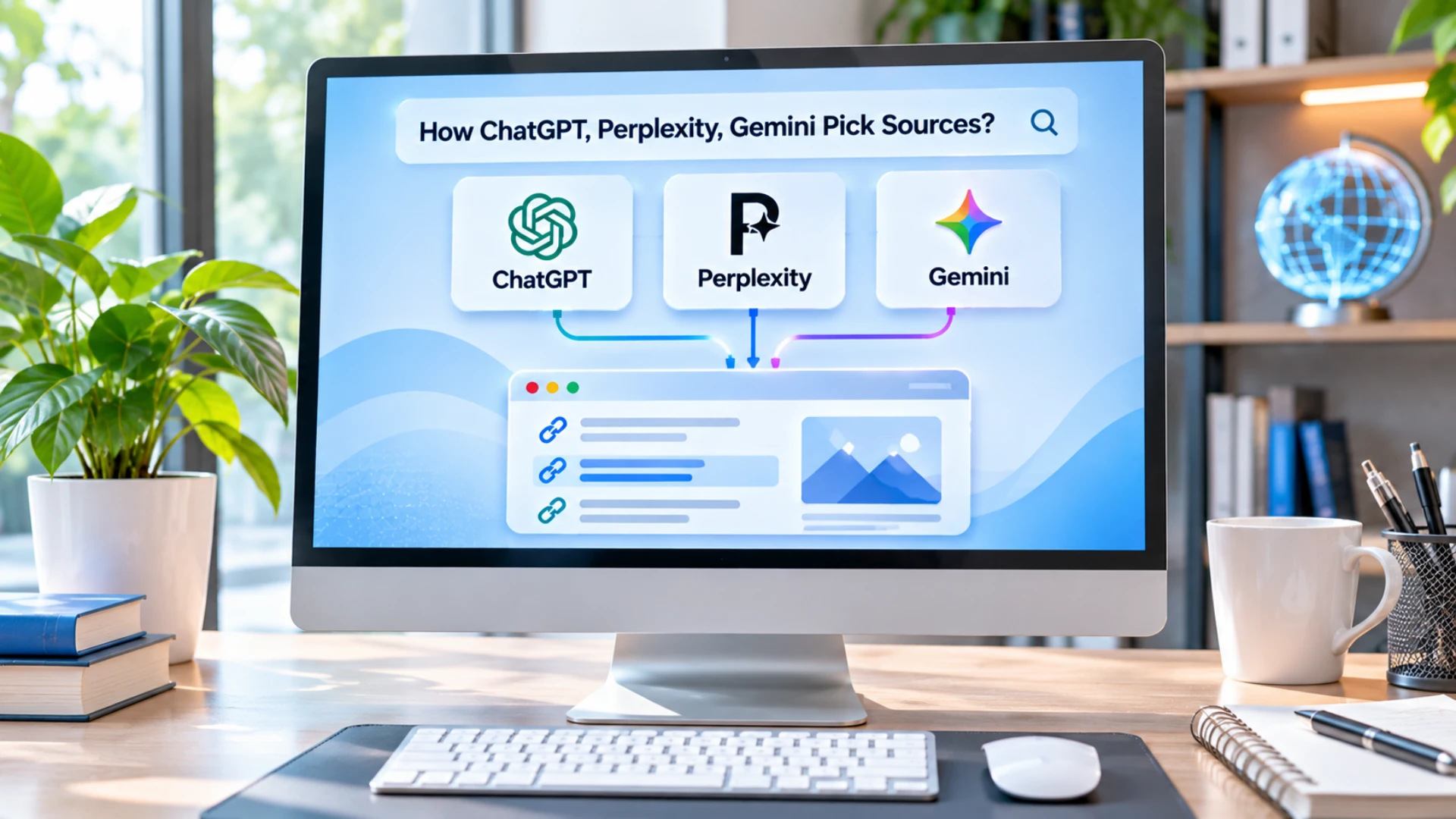
ChatGPT, Perplexity, and Gemini select sources through processes involving information retrieval, relevance assessment, answer matching, and citation selection. Their methods differ by platform, query, and available sources. Websites can improve their potential visibility by maintaining crawlable pages, publishing original evidence, providing direct answers, and strengthening topical relevance.
How ChatGPT, Perplexity, Gemini pick sources is now a practical SEO question, not just an AI curiosity. A page can rank in Google, get crawled, appear in a retrieval pool, and still lose the final citation to a competitor, a Reddit thread, a review page, or a clearer explainer.
That matters because AI answers can shape trust before a user ever clicks. The useful way to understand source selection is not “which AI likes which site,” but how retrieval, filtering, citation choice, and engine-specific behavior work together. For SEOPEZ, this is where AI visibility becomes measurable search work.
Quick Check: If your business needs clearer visibility across AI answers and local search, SEOPEZ can review the source gaps a local seo agency should catch before they become lost citations.
How ChatGPT, Perplexity, Gemini Pick Sources?
The simplest way to understand how ChatGPT, Perplexity, Gemini pick sources is to separate retrieval from citation selection. Retrieval means the system found a possible source. Citation selection means the system decided that source was useful enough to show to the user.
In large-scale ChatGPT citation research, Ahrefs found that many URLs can enter the retrieval process, but only about half of retrieved URLs ultimately receive citations. That gap matters because it shows that “found by the AI” and “credited by the AI” are different outcomes.
Source Selection Breakdown
| Stage | What The AI Is Deciding | What Can Affect The Outcome | What To Check |
|---|---|---|---|
| Discovery / Retrieval | Can the engine find the page? | Indexing, crawl access, topical relevance, query wording, source availability | Technical access, indexability, topical mapping |
| Candidate Filtering | Is the source worth opening? | Title, snippet, URL clarity, source type, semantic match | Search result clarity and page targeting |
| Answer Fit | Does the page help answer this prompt? | Specificity, original value, direct answer structure, evidence | Content depth and answer-level usefulness |
| Citation Display | Should the source be credited? | Platform behavior, prompt wording, model choice, source mix | Citation tracking across engines |
This is why AI source visibility should not be treated as a single ranking report. A brand can be absent because the page is not indexed, because the topic is covered too broadly, because another source answers the subquestion better, or because the AI engine uses a different retrieval path for that prompt.
For teams new to this shift, GEO and traditional SEO differences help explain why classic rankings still matter but no longer explain the whole visibility problem. The page needs to be discoverable, but it also needs to deserve the citation inside the answer.
Why Google Ranking Does Not Guarantee Citation?
A high organic ranking can help discovery, but it does not guarantee that ChatGPT, Perplexity, Gemini pick sources from the same ranked list a user sees in a browser. AI systems often reformulate the prompt, retrieve multiple candidate pages, compare answer fit, and choose the source that supports the generated response.
Google’s own guidance around AI search features makes this distinction important. Pages still need to be indexed and eligible for Google Search, but technical eligibility does not mean a page will automatically appear as a supporting link in AI Overviews or AI Mode.
That is why a page ranking well for one visible keyword can still miss the citation. The AI may be answering a hidden subquestion, not the exact query you track. A practical audit should map the main query to related source-selection paths, then check whether the site has content that answers each sub-intent clearly.
This is where Google and AI citation overlap becomes important. The overlap can drop because AI systems are not simply copying visible search results; they are building a source pool around the answer they plan to generate.
Query Fan-Out Changes The Source Pool
When people ask why a small prompt change creates different citations, the answer often starts with query fan-out. A prompt about “best CRM for small teams” may trigger subqueries around pricing, integrations, reviews, support, alternatives, or use cases. A prompt about “CRM for agencies” may produce a different source pool.
Google has confirmed that its AI search systems can use query fan-out, where a complex question is broken into related searches across subtopics and data sources. That means the source pool can change even when the user’s visible prompt changes only slightly.
For ChatGPT, Perplexity, and Gemini, the practical lesson is the same: cover the real subquestions, not fake keyword variations. Strong AI-ready content answers meaningful branches of the topic, including definitions, comparisons, process steps, requirements, drawbacks, measurement, examples, and decision criteria.
A stronger approach is to study the AI query fan-out process and build pages that answer useful branches of the topic. That gives AI systems more specific passages to retrieve when the prompt shifts.
ChatGPT Source Picking Depends On Retrieval Fit
ChatGPT Search can cite sources from the web, but that does not mean ChatGPT simply cites the top result from a search engine. The available evidence points to a multi-stage process: retrieve candidates, evaluate candidate information, open selected pages, generate the answer, and cite supporting sources.
This makes title clarity and answer alignment important. If the page title, URL, headings, and opening sections do not clearly match the likely AI subquery, the page may be skipped before the deeper content is considered.
A retrieved page also needs to support the final answer. If another source provides a cleaner explanation, more direct evidence, stronger comparison, or better passage-level answer, that source may win the citation even if your page was also discovered.
This is why content optimization techniques need to move beyond adding keywords. The content must make the page’s exact answer obvious at the retrieval, section, and passage level.
Perplexity Source Picking Is Research-First
Perplexity is built around answer generation with source links, so its source behavior is often closer to live research than static model recall. Perplexity operates its own crawler and also uses third-party crawling partners to help build its search index.
That creates a clear visibility checklist for Perplexity: crawl access, useful page summaries, clear topic ownership, and trustworthy supporting details. If the page is blocked, vague, duplicated, or hard to parse, it may lose to a clearer third-party source.
Perplexity can also surface forums, articles, academic papers, videos, and other source types depending on the question. That is why Perplexity visibility should not be limited to a brand’s own website. Credible third-party pages can influence what the system finds, compares, and cites.
For teams comparing AI visibility work with conventional SEO, the GEO SEO and AEO framework gives a cleaner way to separate rankings, answer visibility, and citation presence without blending them into one vague metric.
Gemini Source Picking Is Tied To Google Systems
Gemini can use public information from Google Search in supported experiences, and Gemini Deep Research includes Google Search as a default research source unless settings are changed. That makes Gemini different from a standalone crawler-only model.
Because Gemini is closely connected to Google’s information systems, conventional search eligibility still matters. Pages need to be crawlable, indexable, clear, and useful enough to support a generated answer.
At the same time, Gemini’s displayed sources can vary based on feature, prompt, location, model behavior, selected research mode, and source availability. A page may be eligible for search visibility but still lose the supporting citation to a source that better matches the generated answer.
This is where technical SEO fundamentals still matter. AI search does not remove crawlability, indexation, page rendering, internal links, or snippet control from the work; it raises the cost of ignoring them.
Schema Helps Clarity, Not AI Magic
A common mistake is assuming ChatGPT, Perplexity, Gemini pick sources because a site has special AI schema. That is not supported. Google has said that special AI markup, AI text files, llms.txt files, and artificial content chunking are not required for visibility in its generative search features.
That does not make schema useless. Conventional structured data can still help search engines understand eligible page elements when it is accurate and compliant. The problem is treating schema as a shortcut for weak content, poor indexing, or unclear topical coverage.
The practical rule is simple: use schema where it accurately describes the page, but do not expect markup to compensate for commodity content. The source still needs to answer the question better than other available candidates.
For site owners trying to separate useful markup from myths, schema markup fundamentals are a safer place to start than chasing AI-specific tags that major platforms have not confirmed as ranking requirements.
Third-Party Sources Influence AI Answers
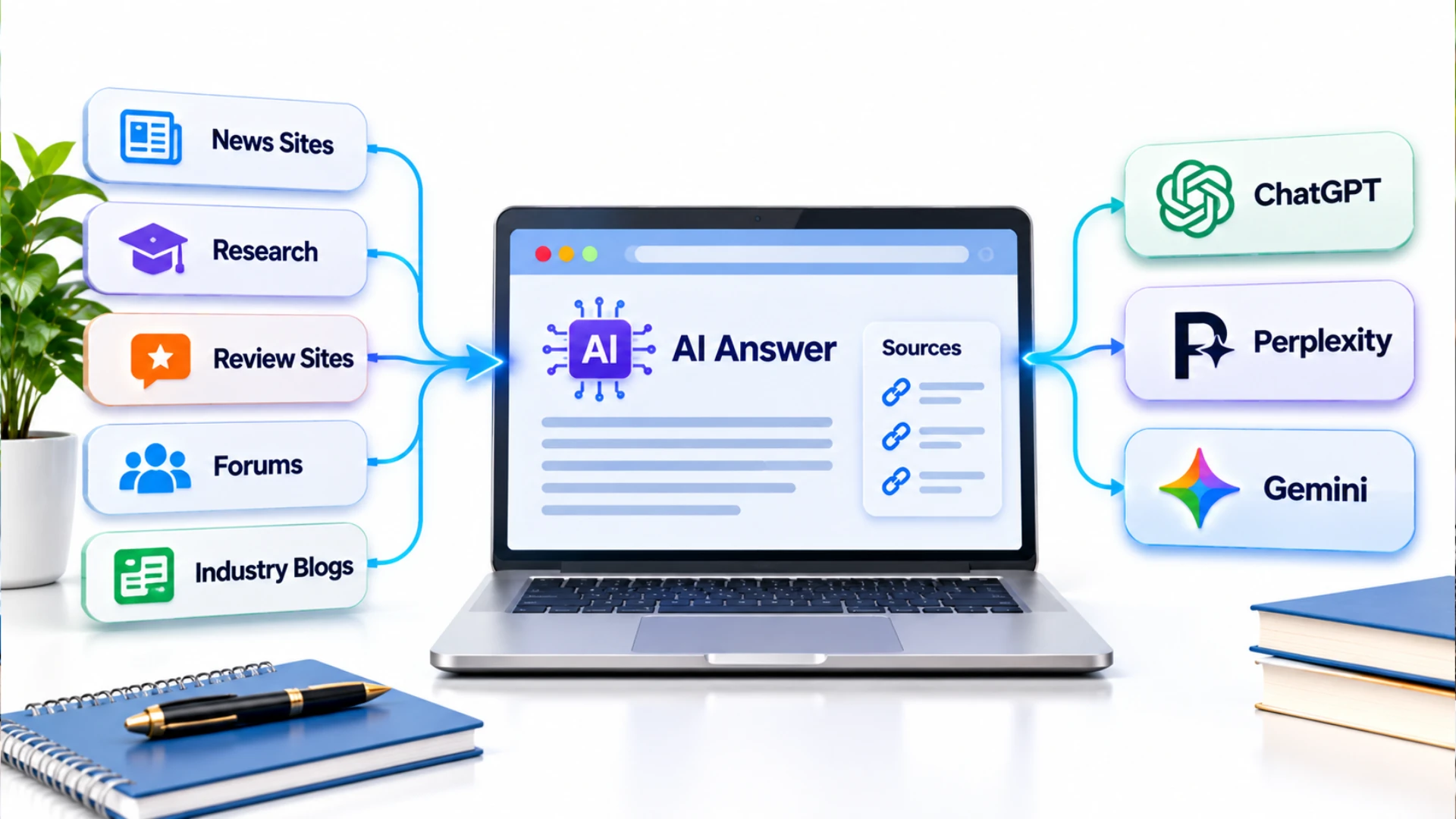
One reason AI source behavior surprises publishers is that the cited source is not always the brand’s own website. The answer may mention a company while citing a review site, a Reddit discussion, a YouTube video, a LinkedIn post, a directory, a comparison page, or a publisher article.
Large AI citation studies have repeatedly shown that third-party sources such as Reddit, YouTube, LinkedIn, Wikipedia, Forbes, G2, Yelp, Facebook, Medium, and TechRadar can appear frequently across AI answer systems. The exact mix changes by engine, prompt set, date, and market.
The safe conclusion is not “post on Reddit and AI will cite you.” The safer conclusion is that third-party environments can shape what AI systems find, compare, and cite. A brand’s off-site footprint can support or weaken the answer an AI engine may generate.
This connects directly to AI-driven search behavior: users may form opinions from AI summaries, cited communities, and third-party proof long before they land on the brand’s site.
Generic Content Loses Citation Reasons
If twenty companies publish the same definition, checklist, or “complete guide,” an AI system has little reason to choose one over another. The page may be retrievable, but it may not be the most useful citation for the generated answer.
Citation-worthy content usually has sharper value: original examples, first-hand process notes, comparison logic, constraints, source-backed explanations, customer questions, visual breakdowns, or better coverage of edge cases. The point is not to write longer pages; it is to make the source harder to replace.
A page that only repeats basic category advice may need clearer experience, stronger internal evidence, or a more specific angle tied to the buyer’s real question. This is especially important when multiple competitors are targeting the same broad informational topic.
Internal structure also matters. A page supported by relevant internal links gives crawlers and AI retrieval systems clearer topical context, which is why internal linking performance signals should be treated as part of AI visibility work, not only classic SEO housekeeping.
What To Measure Beyond Rankings?
If the goal is to understand how ChatGPT, Perplexity, Gemini pick sources, ranking reports are not enough. AI visibility needs separate tracking for brand mentions, cited URLs, source types, answer sentiment, referral traffic, and assisted conversions.
AI Visibility Measurement Map
| Metric | What It Tells You | What It Does Not Prove | What To Track |
|---|---|---|---|
| Brand Mention | The AI named the brand | The brand’s site was cited | Prompt-level mention share |
| URL Citation | A specific URL was credited | The user clicked it | Cited page and source type |
| Third-Party Citation | Another site supports the answer | The brand controls the narrative | Off-site accuracy and visibility |
| Referral Visit | A user clicked from AI search | The visit converted | AI referral sessions |
| Conversion | The visit produced business value | Which citation caused it alone | Assisted paths and lead quality |
This is especially important as zero-click behavior grows. AI answers may satisfy the user before a visit happens, so visibility can affect trust without producing direct traffic in the same session.
That distinction is central to zero-click search measurement. A source citation, a brand mention, and a click are related, but they are not the same business signal.
Tooling also needs to adapt. Teams that rely only on traditional rank tracking may miss where AI engines cite competitors, which prompts trigger third-party sources, and which pages never appear in answer support. That is why SEO tool changes after AI search belong in the same conversation as citation tracking.
How SEOPEZ Applies Source Readiness?
SEOPEZ approaches AI source selection as a search system problem with commercial consequences. The work starts by checking whether pages can be crawled, indexed, rendered, and understood. Then the content is mapped against real user questions, AI-style prompt variations, competitor citations, and third-party source patterns.
For local and global brands, AI visibility often connects with local search signals, service-page quality, entity consistency, and off-site proof. A business can lose citations because its content is thin, its local signals are inconsistent, or third-party sources describe the market more clearly than its own site.
When the problem spans content, technical SEO, local visibility, and AI answer tracking, SEOPEZ can connect the work through cross-channel SEO planning. That matters because source selection is rarely fixed by one content edit.
The basics still matter. If a page has crawling issues, canonical confusion, weak internal links, missing sections, or poor snippet clarity, it may never reach the point where an AI engine can select it. For that layer, Google indexing issue checks remain one of the first practical steps.
If you want to know how ChatGPT, Perplexity, Gemini pick sources for your market, SEOPEZ can turn the question into a working audit. The process reviews what engines cite now, which prompts matter, which pages are missing, and which third-party sources influence the answer.
For businesses that need local and AI visibility together, a local seo agency can help connect citation readiness with search demand, service pages, and measurable leads. The goal is practical: improve what can be crawled, strengthen what can be cited, and measure what actually moves.
FAQs
Why Do ChatGPT, Perplexity, And Gemini Cite Different Sources?
ChatGPT, Perplexity, and Gemini cite different sources because they do not use one shared retrieval system. Each engine has its own source access, model behavior, prompt handling, crawler rules, and citation display logic. Gemini can draw on Google Search in supported experiences, Perplexity uses crawler-based research systems, and ChatGPT Search has its own web-source discovery path. The same prompt can therefore produce different candidate pools before citation selection even begins.
Why Can A Page Rank In Google But Not Get Cited By AI?
A page can rank in Google but not get cited by AI because ranking is mainly a discovery signal, while citation is an answer-support decision. An AI system may retrieve the page, compare it with other candidates, and decide another source better supports the answer. This is why Google ranking and AI citation should be measured separately. Ranking can help a page enter the source pool, but it does not guarantee the final citation.
Does Query Fan-Out Affect Which Sources AI Engines Find?
Query fan-out can affect which sources AI engines find because it changes the search path behind the user’s prompt. A broad prompt may be broken into several related searches across subtopics, comparisons, requirements, examples, and decision points. That means a page optimized only for the surface-level keyword may miss related subquestions that shape the final source pool. Strong AI visibility work studies those subquestions instead of chasing thin keyword variations.
Does Schema Markup Help ChatGPT, Perplexity, Or Gemini Pick Sources?
Schema markup can help search systems understand page elements when it is accurate, but there is no confirmed special schema that forces ChatGPT, Perplexity, or Gemini to cite a page. The better use of schema is to support clear, compliant search understanding while the content itself earns citation value. Schema should clarify what is already useful on the page, not act as a replacement for original, specific, well-structured content.
Why Do Reddit And Third-Party Sites Appear In AI Citations?
Reddit and third-party sites appear in AI citations because many AI systems draw from more than brand-owned websites. Forums, videos, directories, review pages, publisher articles, and social platforms can all provide context for user questions. Their presence in citation datasets does not mean every post or mention will be cited. It means off-site visibility can influence what AI systems find, compare, and use as support.
Can A Brand Be Mentioned Without Its Own Website Being Cited?
Yes, a brand can be mentioned without its own website being cited. An AI answer may name a company while using a third-party comparison, review, forum discussion, directory, or publisher page as the supporting source. This is why brand mentions and URL citations should be tracked separately. The brand may be visible in the answer, but the authority behind that statement may belong to another website.
How Often Should AI Citation Visibility Be Checked?
AI citation visibility should be checked on a recurring basis because source behavior changes by prompt, engine, date, model, location, and available source pool. A one-time test can show what happened on that day, but it cannot prove stable visibility. A better approach is to track a controlled set of prompts across ChatGPT, Perplexity, Gemini, and relevant Google AI surfaces, then log mentions, citations, cited URLs, and source types over time.
What Makes One Page More Citation-Worthy Than Similar Pages?
A page becomes more citation-worthy when it answers a specific question better than interchangeable alternatives. Clear titles, focused headings, direct explanations, original examples, first-hand process details, supporting evidence, and useful comparisons all help a source stand apart. The page also needs to be technically accessible and internally supported. Citation value comes from both sides: the source must be findable, and it must give the AI system a clear reason to cite it.
Want us to handle it for you?
See the sites, the numbers and the price before you order.