
Bing Webmaster Tools provides an AI Performance report that helps website owners analyze how their content appears in Microsoft Copilot and AI-generated search experiences. It includes citation activity, cited pages, grounding queries, and visibility trends. Businesses can use this information alongside technical SEO, IndexNow, and analytics to improve content relevance and monitor AI search visibility.
Using Bing Webmaster Tools for Copilot Data matters because AI search visibility is no longer limited to rankings, impressions, and clicks. Microsoft introduced AI Performance in Bing Webmaster Tools in public preview to show how publisher content appears across Microsoft Copilot, AI-generated summaries in Bing, and selected partner integrations.
The report shows citations, cited URLs, grounding queries, and citation trends, giving SEO teams a direct view into how content participates in AI-generated answers. SEOPEZ uses this data to connect Bing SEO, GEO, technical SEO, content structure, and AI citation analysis into one practical measurement workflow.
Quick Check: If you want to understand whether your pages are visible in Copilot, Bing AI summaries, and AI-driven citation paths, SEOPEZ can support that work through bing seo optimization focused on crawl health, structured content, IndexNow, and AI Performance review.
Using Bing Webmaster Tools For Copilot Data Explained
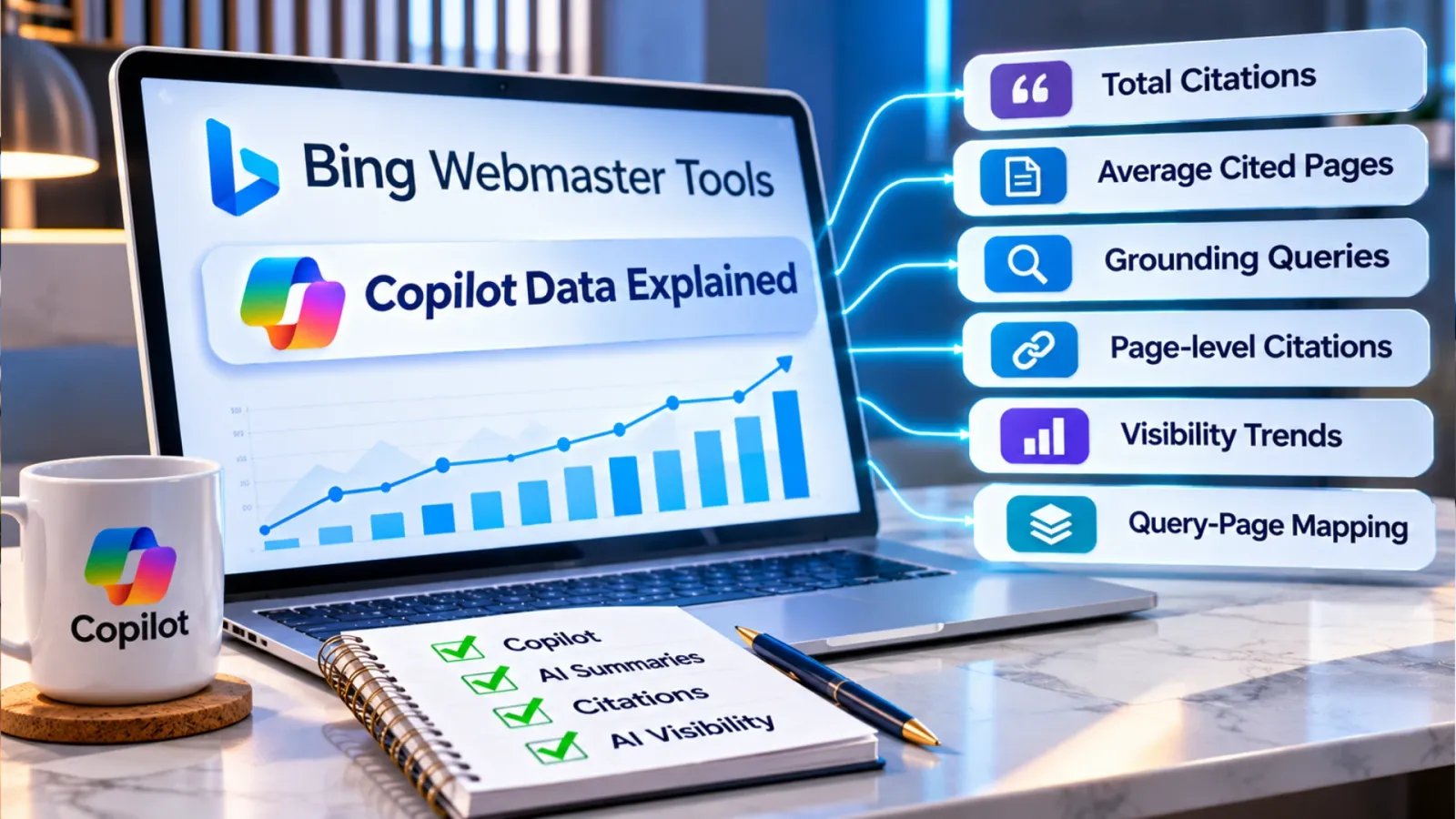
Using Bing Webmaster Tools for Copilot Data starts with the AI Performance report. Microsoft says the report shows how publisher content appears across Microsoft Copilot, AI-generated summaries in Bing, and selected partner integrations. It also shows how often content is cited in generative answers, which URLs are referenced, and how citation activity changes over time.
What Bing AI Performance shows
| Data point | What it means | How SEOPEZ uses it |
|---|---|---|
| Total citations | How often your content appears as a cited source in AI-generated answers | Measures AI visibility beyond classic Bing rankings |
| Average cited pages | Average number of unique site pages cited per day | Checks whether AI visibility is concentrated or distributed |
| Grounding queries | Key phrases AI used when retrieving cited content | Finds AI intent patterns that may differ from normal keywords |
| Page-level citation activity | Citation counts for specific URLs | Identifies pages Copilot and AI summaries already rely on |
| Visibility trends | Citation activity over time | Tracks whether content updates increase or reduce AI inclusion |
| Query-page mapping | Grounding queries connected to cited URLs | Shows which pages support which AI retrieval themes |
This is not the same as a standard traffic report. Microsoft says total citations indicate references in AI-generated answers without showing placement or presentation inside a specific answer, and page-level citation activity reflects citation count, not page importance, ranking, or placement. For SEOPEZ, that makes the report useful but not complete. It shows AI inclusion signals, not final business value by itself.
Copilot Data Is Citation Data First
Using Bing Webmaster Tools For Copilot Data requires the right expectation. The report does not replace analytics, rank tracking, CRM attribution, or conversion tracking. It gives a new visibility layer: whether Microsoft’s AI systems cite your site when generating answers.
That matters because Microsoft describes AI Performance as an early step toward GEO tooling in Bing Webmaster Tools. Microsoft also says visibility is not only about blue links anymore; it is also about whether content is cited and referenced when AI systems generate answers.
SEOPEZ treats Copilot data as a source-inclusion signal. A page with citations is not automatically winning commercially. A page with no citations is not automatically poor. The useful question is narrower: which pages and query themes are trusted enough to appear as sources in Microsoft AI experiences?
This is why a broader AI visibility measurement stack is important. Bing Webmaster Tools can show citation activity, while analytics, CRM data, rank tracking, and server logs help explain whether those visibility signals connect to traffic, leads, and revenue.
Grounding Queries Reveal AI Retrieval Intent
The most useful part of Using Bing Webmaster Tools For Copilot Data is often the grounding query view. Microsoft defines grounding queries as the key phrases the AI used when retrieving content that was referenced in AI-generated answers. Microsoft also notes that this data represents a sample of overall citation activity.
Grounding queries are not always the same as the user’s original prompt. They can represent how the AI system breaks a task into retrieval phrases. For example, a user may ask Copilot for a broad recommendation, while the retrieval layer may look for definitions, comparisons, proof points, specifications, eligibility rules, or recent updates.
SEOPEZ uses grounding queries to find the hidden structure behind AI visibility. If the same theme repeatedly triggers citations, that topic may deserve a deeper hub page, clearer headings, updated statistics, or stronger internal support.
This connects directly to AI query expansion mechanics. Query fan-out and grounding are not identical terms, but both show the same strategic point: AI search often works through multiple retrieval steps, not one visible keyword.
Query-Page Mapping Turns Data Into Action
Microsoft later highlighted a feature connecting Grounding Queries and Page views. The mapping lets users see which pages are cited for a specific grounding query and which grounding queries are associated with a specific cited page. Microsoft also notes that one grounding query may map to multiple pages, and one page may map to multiple grounding queries.
For SEOPEZ, this mapping is where the report becomes operational. It can answer questions such as:
| SEO question | Copilot data to review | Likely action |
|---|---|---|
| Which pages does AI already cite? | Page-level citation activity | Strengthen and protect those pages |
| Which AI intents cite us? | Grounding query list | Expand related sections and FAQs |
| Which pages support several intents? | Query-page mapping | Build internal links and supporting assets |
| Which important pages are absent? | Cited pages versus priority pages | Improve clarity, depth, structure, and indexing |
| Which themes are growing? | Citation trend line | Update pages and create new supporting content |
A standard SEO report may show that a page ranks for a keyword. Copilot data may show that the same page supports a different AI retrieval phrase. SEOPEZ uses that difference to adjust content briefs, not just titles.
Bing SEO Fundamentals Still Matter
Using Bing Webmaster Tools for Copilot Data does not mean ignoring standard Bing SEO. Microsoft says Bing Webmaster Tools provides search performance reporting, URL inspection, IndexNow, keyword research, Copilot assistance, backlink insights, Site Explorer, sitemaps, Site Scan, robots.txt testing, and Crawl Control.
That matters because Copilot visibility still depends on discoverable, understandable, fresh content. If a page is blocked, stale, poorly structured, slow to update, or unclear, AI citation potential becomes harder to diagnose.
SEOPEZ begins with a practical audit. The work includes verifying site ownership, checking crawlability, submitting sitemaps, using IndexNow where appropriate, reviewing indexed URLs, inspecting priority pages, and comparing AI Performance data against normal search performance.
The natural starting point is a site diagnostic workflow. Before treating a missing Copilot citation as a GEO problem, SEOPEZ checks whether Bing can crawl, understand, and index the page properly.
IndexNow Helps Keep AI Sources Fresh
Microsoft’s AI Performance announcement says accurate and up-to-date content is important for inclusion and citation in AI-generated answers. It also says IndexNow helps keep information fresh across search and AI experiences by notifying participating search engines when content is added, updated, or removed.
For SEOPEZ, this makes IndexNow part of the Copilot data workflow. If a page is updated to improve clarity, add evidence, revise outdated sections, or fix technical issues, Bing should be notified quickly. Waiting passively for recrawling can slow the feedback loop.
IndexNow is not a ranking guarantee. It is a discovery and update signal. The practical value is speed: pages that change often, such as pricing, product details, guides, locations, FAQs, and news-like resources, can be refreshed faster across participating engines.
This is where crawl and indexing controls matter. A fast notification system only helps when the page itself is accessible, canonicalized correctly, internally linked, and technically clean.
Copilot Data Changes Content Priorities
Using Bing Webmaster Tools For Copilot Data gives content teams a better way to prioritize updates. Instead of only asking which pages get the most traffic, SEOPEZ asks which pages are already cited, which grounding queries they support, and which important topics have weak AI visibility.
Microsoft’s AI search content guidance says traditional SEO fundamentals still matter, including crawlability, metadata, internal linking, and backlinks. It also says AI search selection is less about ordering whole pages and more about which pieces of content earn a place in the final answer.
That is a major content shift. A page needs self-contained explanations, clear headings, direct answers, tables, Q&A blocks, evidence, and semantic clarity. Copilot data can show whether that structure is working.
SEOPEZ uses content clarity refinement to improve pages that are indexed but less visible in AI answers. The goal is not to stuff more Bing keywords into the page. The goal is to make each section easier for AI systems and human readers to interpret.
Source Selection Is the New SEO Layer
Microsoft’s search team explains that traditional search and grounding systems share the same foundation, but they optimize for different outcomes. Traditional search asks which pages a user should visit. Grounding asks what information an AI system can responsibly use to construct a response.
That difference explains why Using Bing Webmaster Tools For Copilot Data belongs inside GEO work. A page can rank and still fail to become a useful source for an AI answer. A page can also become useful for a specific grounding query even if it is not the main organic landing page for a short keyword.
SEOPEZ reviews content at the source level. The team checks whether the page provides discrete, supportable facts, clear provenance, updated details, consistent entity language, and enough context to avoid ambiguity. That supports both Bing SEO and Copilot citation potential.
A useful companion concept is AI source evaluation signals. Different AI systems have different interfaces and data sources, but they all need retrievable, reliable, clearly structured information.
Citation Gaps Require Separate Analysis
Using Bing Webmaster Tools For Copilot Data often reveals a gap between classic SEO success and AI citation success. A page might receive Bing impressions but no AI citations. Another page might appear in Copilot citations but send little measurable referral traffic.
That does not make the report inaccurate. It means citation visibility and click traffic are different metrics. Microsoft’s dashboard is designed to show citation participation, not complete click-through attribution from every AI answer.
SEOPEZ separates these layers during reporting:
| Layer | Main question | Main tool |
|---|---|---|
| Crawl layer | Can Bing access the page? | URL Inspection, Site Explorer, robots testing |
| Search layer | Does the page appear in Bing results? | Search Performance |
| AI citation layer | Is the page cited in Copilot or AI summaries? | AI Performance |
| Engagement layer | Do users visit and act? | Analytics, CRM, call tracking, forms |
| Content layer | Does the page answer the right intent? | Manual review, content audit, grounding query review |
This is where AI citation mismatch analysis helps. Ranking and AI citation are related, but they should not be treated as identical outcomes.
GEO, SEO, and AEO Need One Dashboard

Using Bing Webmaster Tools For Copilot Data makes the SEO, GEO, and AEO distinction practical. SEO ensures pages can be crawled, indexed, ranked, and understood. GEO focuses on visibility in generative answers. AEO focuses on extractable answers and response-ready formatting.
SEOPEZ does not split these into disconnected services. A page that performs well in Copilot data usually needs all three: technical accessibility, topical authority, answer clarity, structured sections, and trustworthy evidence.
The generative visibility definition helps teams understand why GEO is not a replacement for SEO. The answer optimization role map helps decide whether a page needs crawl fixes, content expansion, answer formatting, citation strengthening, or better internal support.
Zero-Click Behavior Makes Citations Valuable
Copilot citations matter because AI search can answer more questions before the user clicks. Microsoft says AI Performance helps brands move beyond traffic-only measurement and start optimizing for AI discovery. It also says content may already shape decisions even if it is not driving immediate traffic.
That is the reason SEOPEZ does not treat zero-click behavior as a reason to stop optimizing. A citation can influence awareness, trust, comparison, and later branded search. It may not always appear as a direct session in analytics.
A strong Copilot data process therefore looks at citations, branded search movement, Bing impressions, referral traffic, assisted conversions, and CRM quality together. The AI answer attention shift gives teams a useful frame for interpreting visibility that does not always produce a direct click.
Brand Mentions Support AI Recognition
Using Bing Webmaster Tools For Copilot Data also raises a brand question. If Copilot cites a page, the page is functioning as a source. But broader brand recognition may depend on consistent mentions, entity clarity, third-party references, and topical association across the web.
SEOPEZ checks whether the brand is easy to identify on cited pages. The page should explain who the company serves, what it does, what topic it owns, and why its information is relevant. This is especially important for service brands that want AI systems to connect content expertise with commercial fit.
The entity mention visibility pattern helps explain why not every useful signal is a clickable backlink. In AI search, brand references, citations, and consistent topical associations can help systems understand the entity behind the content.
Schema Supports Interpretation
Schema markup is not a Copilot citation guarantee. Still, it supports machine understanding when it accurately matches visible content. Microsoft’s AI search guidance says schema labels content as a product, review, FAQ, or event, turning plain text into structured data that machines can interpret with more confidence.
SEOPEZ reviews schema as part of Using Bing Webmaster Tools For Copilot Data because the report can identify pages worth strengthening. If a frequently cited page lacks appropriate structured data, adding valid schema may improve clarity. If a priority page has schema that does not match the visible content, it should be corrected.
The best schema work is practical: Organization, Article, FAQ, Breadcrumb, Product, Service, or LocalBusiness markup where relevant. The machine-readable markup basics resource helps teams understand the foundation without treating schema as a shortcut.
Keyword Research Becomes Grounding Research
Using Bing Webmaster Tools For Copilot Data changes keyword research. Traditional keyword research still matters, but grounding queries add another layer: the phrases AI systems use to retrieve cited content.
SEOPEZ compares keyword data against grounding query data. If a page ranks for a commercial keyword but gets cited for an informational grounding phrase, the page may need clearer sections for both intents. If a high-priority keyword has no citation activity, the page may need stronger definitions, examples, evidence, or internal links.
This is where intent pattern discovery becomes useful. Keyword research should identify what people search. Grounding query analysis should identify how AI systems retrieve and assemble supporting information.
New Sites Need Stronger Bing Foundations
New websites should not expect immediate Copilot visibility just because they publish AI-optimized content. Bing and Copilot still need discoverable pages, consistent signals, clean site architecture, and enough topic depth to understand the site.
SEOPEZ helps new sites set up Bing Webmaster Tools, verify ownership, submit sitemaps, enable IndexNow where appropriate, run Site Scan, inspect priority URLs, and review early AI Performance signals when available. For a new site, the first objective is stable discovery and clean indexing. AI citation improvement comes after the foundation is visible.
The early site visibility framework is useful because new websites often confuse low citation data with a content failure. Sometimes the issue is simpler: not enough crawl history, weak internal structure, thin topical coverage, or poor technical setup.
Mistakes That Distort Copilot Data
Using Bing Webmaster Tools For Copilot Data can mislead teams when the data is interpreted without context. SEOPEZ watches for several common mistakes.
First, do not treat citations as rankings. Microsoft says citation count does not indicate ranking, placement, authority, or the role of a page within an individual answer. Second, do not treat missing citation data as proof that a page has no value. The report is a visibility signal across supported experiences, not a full-market AI audit.
Third, do not rewrite every page based on one short date range. Citation trends need time, and content changes need crawl and processing time. Fourth, do not ignore technical problems. If Bing cannot access or interpret a page, content edits alone may not fix citation visibility.
The SEO issue prevention list helps teams avoid overreacting to one metric while missing the structural causes that suppress search and AI visibility.
SEOPEZ Workflow For Copilot Data
SEOPEZ uses a repeatable workflow for Using Bing Webmaster Tools For Copilot Data.
First, verify Bing Webmaster Tools access and check normal search performance. Second, inspect priority URLs for crawl and indexing issues. Third, review AI Performance for total citations, cited pages, grounding queries, page-level citation activity, and trend movement. Fourth, map grounding queries to pages. Fifth, update content structure, schema, internal links, freshness signals, and IndexNow submission. Sixth, compare citation movement against business metrics.
For businesses that need a broader diagnostic, SEOPEZ can provide an seo analysis service that reviews technical SEO, Bing visibility, page structure, indexing, AI citation signals, and content gaps together.
The main advantage is focus. Copilot data tells you where Microsoft’s AI ecosystem already sees source value. SEOPEZ turns that signal into page updates, topic expansion, internal linking, and measurement improvements that support both Bing SEO and GEO.
If your team wants to use Microsoft’s AI Performance data properly, SEOPEZ can turn the report into a practical roadmap. Through bing seo optimization, the team reviews crawl access, IndexNow, grounding queries, cited pages, technical barriers, structured content, schema, and AI-search reporting. The goal is not to chase citations in isolation. The goal is to make your website clearer, more current, and more useful across Bing, Copilot, and AI-generated search experiences.
FAQs About Using Bing Webmaster Tools For Copilot Data
What does Using Bing Webmaster Tools For Copilot Data mean?
Using Bing Webmaster Tools For Copilot Data means reviewing the AI Performance report inside Bing Webmaster Tools to understand how your pages appear as cited sources in Microsoft Copilot, Bing AI-generated summaries, and selected partner integrations. The report includes total citations, cited pages, grounding queries, page-level citation activity, and trend data. It helps SEO teams measure AI visibility beyond traditional rankings and clicks.
Does Bing Webmaster Tools show Copilot clicks?
Bing Webmaster Tools AI Performance is mainly a citation visibility report, not a complete click attribution report. Microsoft describes the dashboard around citations, grounding queries, cited URLs, and visibility trends. That means SEO teams should not use it as the only performance source. SEOPEZ pairs AI Performance data with Bing search performance, analytics, CRM data, and conversion tracking to understand whether AI visibility contributes to business outcomes.
What are grounding queries in Bing Webmaster Tools?
Grounding queries are the key phrases Microsoft’s AI systems used when retrieving content that was cited in AI-generated answers. They are useful because they can reveal how Copilot interprets a topic, not just what users typed into a classic search box. SEOPEZ uses grounding queries to identify content gaps, improve headings, expand related sections, and build pages that better support AI answer construction.
How should I optimize pages cited by Copilot?
Start by protecting and improving the pages that are already cited. Check whether the page is current, clear, well-structured, internally linked, and supported by evidence. Add stronger headings, concise answers, useful tables, FAQs, schema where appropriate, and updated examples. Then use IndexNow to help Bing discover important changes faster. The goal is to make the cited page more reliable and easier for AI systems to reference accurately.
Why do my Bing rankings and Copilot citations differ?
Bing rankings and Copilot citations can differ because traditional search and AI grounding optimize for different outcomes. Traditional search asks which pages a user should visit. Grounding asks which information can responsibly support an AI-generated answer. A page can rank but not be cited if it lacks concise, source-ready information. A page can also be cited for a specific grounding query that does not match the main keyword you track.
Is Bing Webmaster Tools enough for GEO measurement?
Bing Webmaster Tools is a strong starting point for Microsoft AI visibility, but it is not enough for complete GEO measurement. It covers supported Microsoft surfaces such as Copilot, Bing AI summaries, and selected partner integrations. It does not fully measure every AI assistant, search engine, citation surface, analytics event, or conversion path. SEOPEZ uses it as one part of a wider GEO reporting system.
How often should I review Copilot data?
Review Copilot data regularly enough to detect changes, but avoid reacting to daily noise. A weekly or biweekly review works for active content programs, while monthly reporting may be enough for stable sites. SEOPEZ recommends reviewing after major content updates, technical releases, sitemap changes, IndexNow implementation, and new topic launches. The most useful trend is whether cited pages and grounding queries improve after specific site changes.
Want us to handle it for you?
See the sites, the numbers and the price before you order.