

Optimizing product pages for AI recommendation involves providing accurate product titles, descriptions, specifications, availability details, structured data, and relevant buyer information. Consistent product feeds, clear variant information, genuine reviews, and logical internal links help search engines and AI shopping systems understand product suitability and support more relevant recommendations.
Optimizing Product Pages for AI Recommendation is now a practical ecommerce SEO priority because AI shopping systems do more than match keywords. They compare attributes, read product pages, interpret feeds, evaluate merchant trust, and summarize options before a buyer reaches a store.
Google’s agentic shopping direction includes Universal Cart, AI Mode shopping, and the Shopping Graph, while OpenAI says ChatGPT shopping can read public retail sites and use merchant product data where available.
SEOPEZ helps ecommerce brands make product pages clearer for people, search engines, and AI recommendation systems without turning pages into thin keyword templates.
Quick Check: If your product pages need stronger visibility in search results, AI shopping answers, and recommendation surfaces, SEOPEZ can support that work through on page seo services built around product content, schema, internal links, and technical clarity.
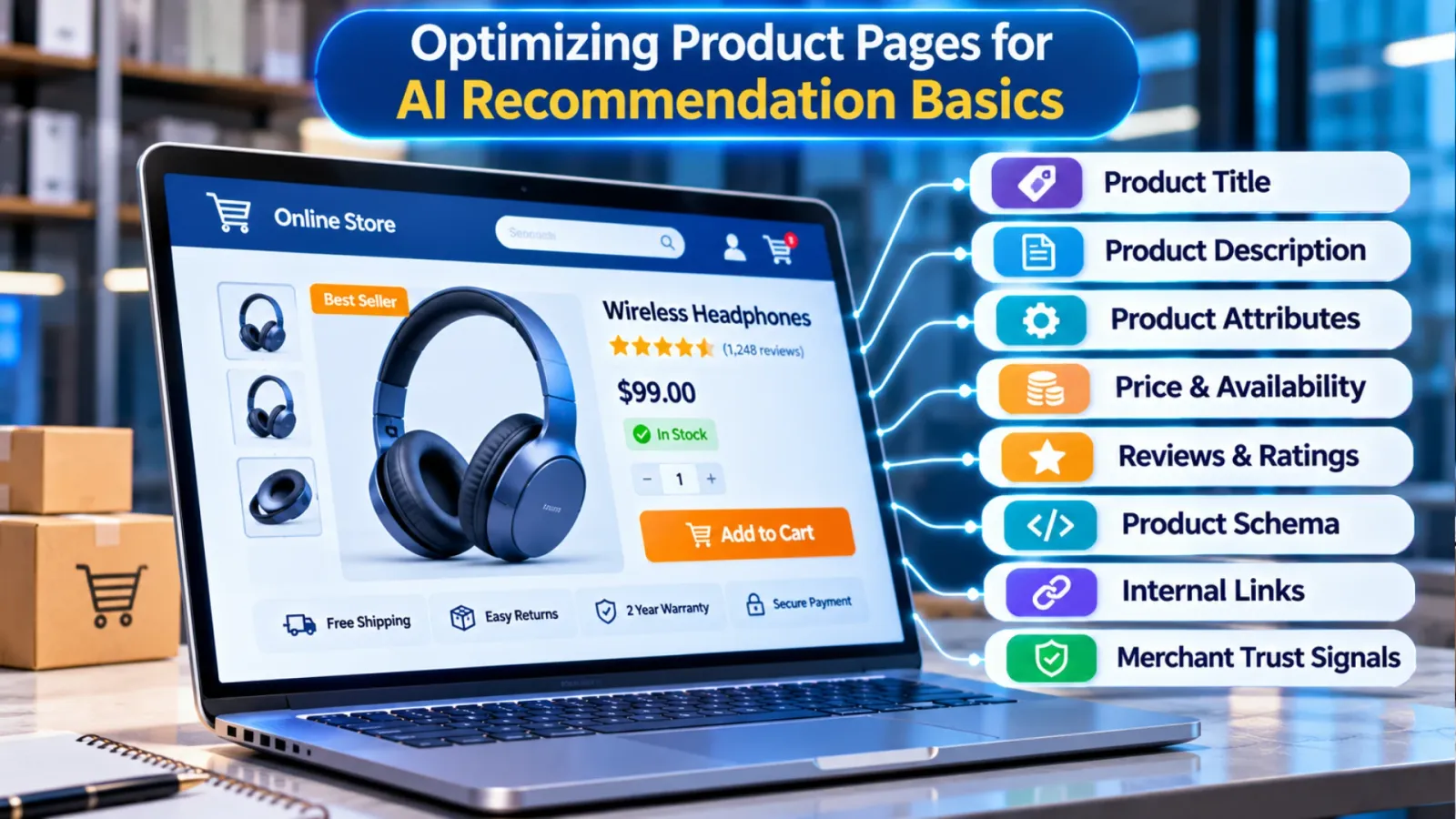
Optimizing Product Pages for AI Recommendation Basics
| Product page element | Why AI systems need it | SEOPEZ improvement focus |
|---|---|---|
| Product title | Identifies the item, model, type, and use case | Clear naming without keyword stuffing |
| Product description | Explains fit, function, constraints, and differentiators | Specific copy based on buyer questions |
| Product attributes | Supports comparison by size, material, compatibility, color, capacity, or variant | Complete, consistent product data |
| Price and availability | Helps shopping systems avoid outdated recommendations | Feed-page consistency and crawlable values |
| Reviews and ratings | Adds buyer experience signals where compliant and genuine | Visible, structured, policy-safe review data |
| Product schema | Helps machines interpret product, offer, rating, and variant details | Valid Product and Offer markup |
| Internal links | Shows category, collection, and related-product context | Logical category-to-product paths |
| Merchant trust signals | Helps users and systems assess reliability | Shipping, returns, support, policies, and identity |
Optimizing Product Pages for AI Recommendation starts with a simple principle: an AI system cannot recommend what it cannot understand. Google says merchants can provide rich product data through Product structured data on product pages, Merchant Center feeds, or both. That means SEOPEZ treats the product page as both a customer-facing sales page and a machine-readable data source.
The strongest product pages do three jobs at once. They answer human buyer questions, give search engines accurate structured data, and give AI recommendation systems enough context to match the product to a real need. The AI discovery behavior changes explain why this matters: buyers are asking longer, more specific questions across search engines, AI assistants, and shopping interfaces.
AI Recommendation Is Attribute Matching
Optimizing Product Pages for AI Recommendation is not only about ranking for “best product” terms. AI shopping systems often need attributes: product category, size, fit, use case, compatibility, price, material, stock status, return policy, and buyer constraints.
OpenAI describes shopping research as an interactive discovery experience that can ask questions, compare products, and use accurate, up-to-date details from high-quality sources. It also says results are organic and based on publicly available retail sites, with product pages read directly and sources cited. For ecommerce brands, that makes incomplete product pages a direct visibility problem.
SEOPEZ improves product pages by turning vague claims into specific attributes. Instead of “premium backpack,” a page should explain capacity, laptop size fit, waterproofing level, strap design, weight, warranty, ideal user, and limits. That level of detail supports both buyers and AI recommendation systems.
The shopper query grouping method helps map those attributes to real buyer language. Product page research should include category terms, comparison modifiers, compatibility questions, use-case phrases, and objection-based searches.
Product Data Must Match the Page
AI recommendations can fail when feed data, structured data, and visible page content disagree. If a feed says one price, the page shows another, and schema gives a third value, search and shopping systems have less confidence in the product.
Google Merchant Center documentation says structured data markup on product landing pages helps Google retrieve up-to-date information about products and offers directly from the website. Google also says structured data can improve the accuracy of its understanding of price, discounts, and shipping costs, and can help Merchant Center verify product feeds against the site.
SEOPEZ checks consistency across visible content, Merchant Center feed fields, Product schema, variant pages, canonical URLs, and inventory systems. Product recommendation visibility depends on trust in the data. When data conflicts, even a strong product may be harder for AI systems to place confidently.
The product schema fundamentals are central here. Schema should describe the visible product accurately. It should not add hidden claims, fake ratings, unsupported offers, or unavailable variants.
Product Schema Should Be in Initial HTML
Optimizing Product Pages for AI Recommendation depends on reliable product markup. Google recommends putting Product structured data in the initial HTML for merchants optimizing for all types of shopping results. Google also warns that JavaScript-generated Product markup can make Shopping crawls less frequent and less reliable, especially for fast-changing content such as price and availability.
SEOPEZ reviews how product data is rendered. If price, availability, variant, or review markup appears only after heavy JavaScript execution, crawlers may receive weaker or delayed signals. That is especially risky for ecommerce sites with frequent inventory changes.
The rendering and crawlability basics help teams understand why product pages need more than attractive design. AI recommendation systems still depend on discoverable content. A visually polished product page can underperform if critical details are blocked, delayed, duplicated, or hidden from crawlers.
Variant Pages Need Clean Identification
Many ecommerce sites struggle with variants. One product may have multiple sizes, colors, bundles, pack counts, or regional versions. AI systems need to know whether those are separate products, offers, or selectable options.
Google Merchant Center guidance says when multiple offers appear on a page, each offer should be annotated with SKU or GTIN, and the same SKU or GTIN should match the corresponding product data in Shopping. That matters because AI recommendations often compare one specific offer, not a vague product family.
SEOPEZ checks whether variants are crawlable, canonicalized correctly, internally linked, and represented consistently in structured data. For example, a shoe page should not confuse color variants, unavailable sizes, and separate product models. A laptop page should make processor, memory, storage, screen size, and warranty options clear.
This work connects to the product page element checklist. Titles, headings, body copy, image alt text, internal links, and schema should all reinforce the exact product being offered.
AI Recommendations Need Commercial and Informational Balance
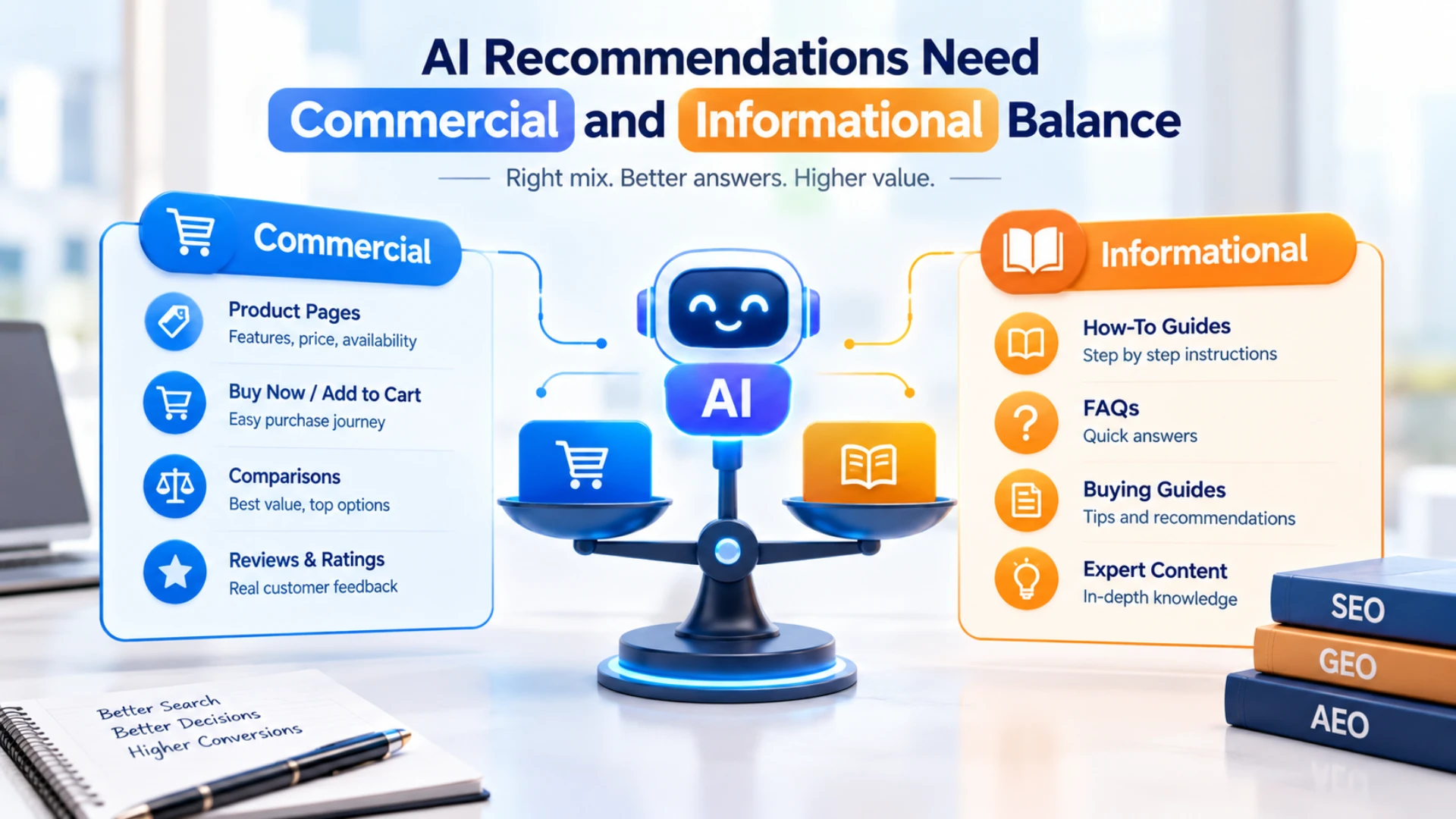
Optimizing Product Pages for AI Recommendation requires a balance between commercial copy and informational clarity. A product page still needs to sell, but AI systems need factual product details they can compare.
A weak page says the product is “perfect,” “premium,” or “must-have” without explaining why. A stronger page explains who the product is for, what problem it solves, what it includes, what it does not include, how it compares to alternatives, and what conditions affect the buyer’s choice.
SEOPEZ uses the intent split between learning and buying to decide what belongs on the page. If the product is technical, buyers may need specifications and compatibility answers. If the product is style-driven, buyers may need material, fit, care instructions, images, and real-use context.
The goal is not to make every product page long. The goal is to make each product page complete enough for its buying decision. A simple item may need concise clarity. A complex item may need comparison tables, FAQs, diagrams, and compatibility notes.
Query Fan-Out Changes Product SEO
AI shopping journeys often break one buyer question into many supporting questions. A user might ask for “a lightweight travel stroller for flights,” while the AI system may retrieve information about stroller weight, fold size, airline carry-on rules, age range, recline options, wheel type, safety certifications, and reviews.
That is why Optimizing Product Pages for AI Recommendation requires more than one target keyword. Product pages should support the main category, the specific product, and the decision criteria that surround the recommendation.
The multi-step retrieval paths show why AI search can expand a prompt into related subtopics. SEOPEZ applies the same logic to ecommerce pages. Each product page should contain enough structured detail to satisfy the hidden comparison path behind buyer prompts.
A product description should therefore include practical buyer attributes, not only brand language. AI systems are more likely to match a product when the page contains concrete, retrievable details.
Content Quality Drives Product Understanding
AI recommendation systems need enough content to understand how a product fits real buyers. Thin manufacturer descriptions, duplicated supplier copy, and generic bullet lists create a weak signal.
SEOPEZ improves product copy with attribute-led content improvements. That includes rewriting descriptions around use cases, adding comparison details, clarifying limitations, answering objections, and removing vague filler.
Product content improvement matrix
| Weak product copy | AI-ready product copy |
|---|---|
| “High-quality travel bag for daily use” | “A 28L water-resistant backpack with padded 15-inch laptop sleeve, side bottle pocket, and luggage pass-through for commuting and short trips” |
| “Great for all skin types” | “Designed for normal to dry skin; patch testing recommended for sensitive skin; fragrance-free formula listed in ingredients” |
| “Fast charger included” | “Includes 65W USB-C charger compatible with supported USB-C laptops, tablets, and phones; charging speed depends on device support” |
| “Comfortable office chair” | “Adjustable seat height, lumbar support, mesh back, tilt tension, and 120kg listed weight capacity for desk work” |
The second version gives AI systems and buyers more usable detail. It explains the product in a way that supports recommendation logic. It also reduces the risk that an AI system chooses a competitor because the competitor’s page is simply clearer.
Titles and Snippets Still Matter
Product recommendations may happen inside AI interfaces, but search snippets still matter. Product titles and descriptions help users and systems understand what the page offers before the click.
SEOPEZ checks whether each product title includes the product type, model, key differentiator, and brand where relevant. The meta description should summarize the product’s use case, important attribute, and reason to compare it. It should not overpromise or copy the same phrase across hundreds of pages.
The title and description snippet rules help keep snippets clear. For product pages, a title like “AeroLite 28L Travel Backpack – Water-Resistant Laptop Bag” is more useful than “Best Backpack Online.” The first version gives a buyer and an AI system concrete product identity.
Strong snippets also support click quality. A clearer snippet brings better-matched buyers to the page, which can improve downstream engagement and conversion signals.
Internal Links Build Product Context
AI recommendation systems benefit when a product sits inside a clear site structure. A product should connect to its category, collection, buying guide, comparison page, related accessories, and support information where relevant.
SEOPEZ uses the category-to-product linking model to show search engines how products relate. For example, a running shoe should connect to men’s running shoes, trail running shoes, shoe size guidance, return policy, and related socks or insoles where useful.
Internal links should not be random. They should explain context. A product page about a beginner camera might link to a lens compatibility guide, memory card category, camera bag category, and beginner photography guide. Those links help buyers continue the journey and help crawlers understand the product ecosystem.
For AI recommendation, this context can help clarify who the product is for and what other products support it.
Reviews, Policies, and Trust Signals Matter
OpenAI’s commerce policies state that merchants may not use commerce features for fraudulent, deceptive, misleading, or unlawful activity, and its standards apply to product listings, feeds, merchants, and linked web pages. That shows why AI recommendation visibility is not only about product keywords. Trust and policy compliance matter.
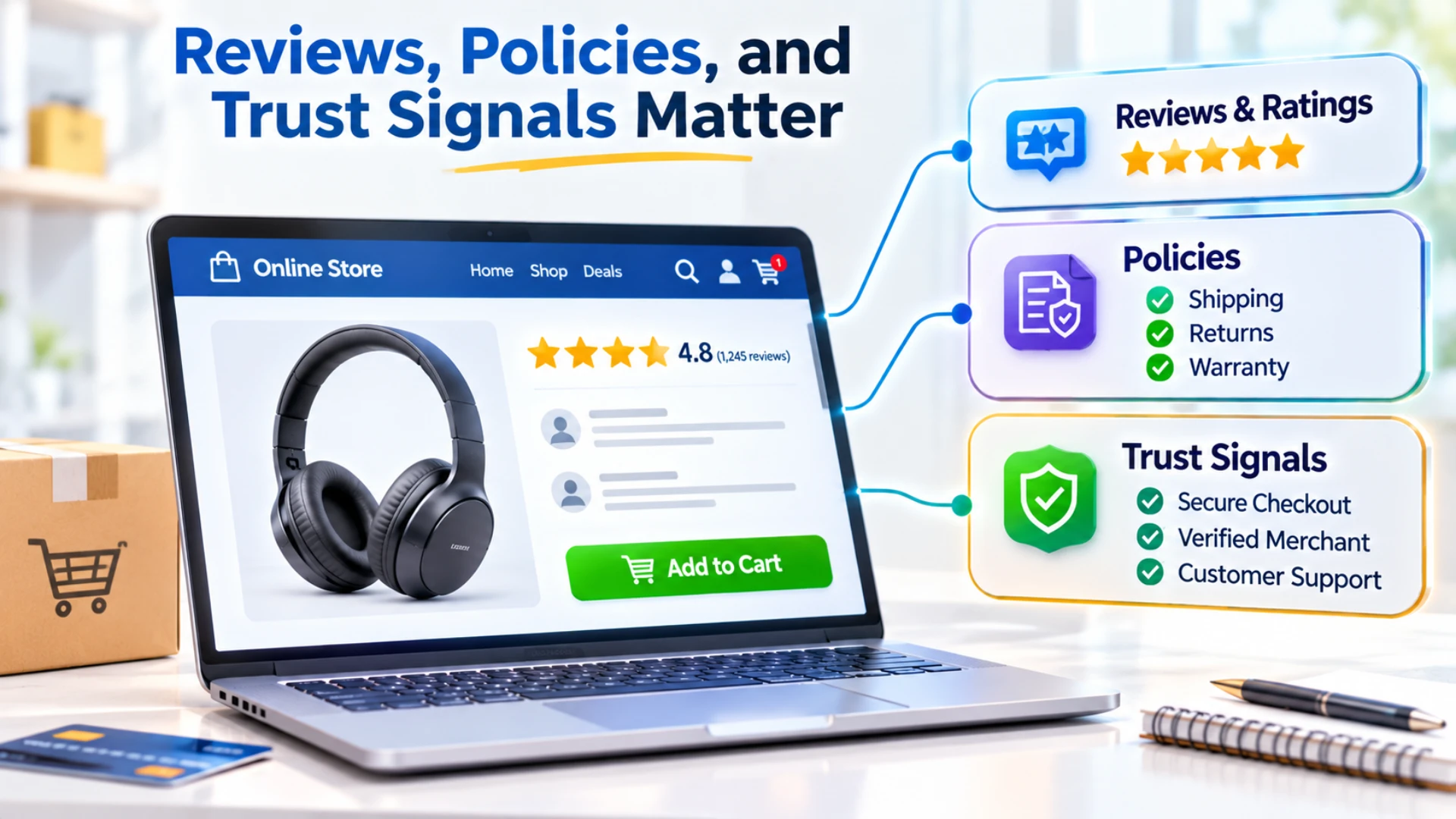
SEOPEZ reviews visible trust signals on product pages. These include shipping policies, return windows, warranty terms, support contact options, secure checkout, merchant identity, authentic reviews, and clear product limitations.
Reviews should be genuine, visible, and compliant. AI systems may use review information to understand buyer satisfaction, but fake or misleading review markup can create risk. A page with honest limitations can also be stronger than a page that pretends every product fits every buyer.
The AI citation source factors are relevant because recommendation systems need reliable source material. Product pages should be specific enough to support confident recommendations.
Brand Signals Support Recommendation Confidence
Optimizing Product Pages for AI Recommendation also depends on brand clarity. AI systems may interpret product pages more confidently when the merchant identity, product ownership, expertise, and support policies are easy to understand.
SEOPEZ checks whether the product page clearly connects to the brand. That includes organization details, product line structure, category expertise, customer support pages, return policies, shipping information, and consistent brand mentions across the site.
The brand mention context signals help explain why entity clarity matters. AI systems do not only evaluate one product page in isolation. They may consider broader web context, merchant consistency, and recognizable product associations.
For ecommerce brands, this means product page SEO should connect to brand SEO. A product can be well described but still lose trust if the merchant is unclear.
Local Ecommerce Pages Need Availability Signals
Local ecommerce brands have an extra layer: buyers may care about pickup, delivery area, store availability, local pricing, and region-specific stock.
SEOPEZ applies regional ecommerce discovery signals when product pages support local purchase paths. That can include store availability, pickup options, delivery rules, local landing pages, store schema, and clear shipping zones.
For AI recommendation, local details help match the product to the buyer’s constraints. A product may be relevant in general but not useful if it cannot be delivered, picked up, or returned in the buyer’s location. Product pages should avoid burying that information inside checkout-only screens.
The goal is to help AI systems and buyers answer: “Can I actually get this product where I am, when I need it, under the conditions I care about?”
GEO Turns Product Pages Into Source Assets
GEO does not replace ecommerce SEO. It adds another layer: making product pages useful inside generative answers and AI recommendation flows.
The GEO and SEO scope differences help clarify the relationship. SEO helps product pages become crawlable, indexable, rankable, and understandable. GEO helps those pages become useful as sources for AI-generated comparisons, summaries, and recommendations.
The answer and generative visibility roles are also useful. AEO supports concise answers such as “Does this product fit X?” GEO supports recommendation inclusion. SEO supports the underlying discovery system.
SEOPEZ brings these together by improving visible content, structured data, internal links, technical setup, and measurement. A product page that cannot rank, cannot be crawled, or cannot be parsed will struggle in AI recommendation systems too.
AI Citation Is Not the Same as Ranking
A product page can rank in search results but fail to appear in AI-generated recommendations. Another page may appear as a cited source for a specific comparison without being the top organic result for a broad keyword.
This is why SEOPEZ separates ranking performance from AI citation and recommendation visibility. The ranking citation separation helps teams avoid assuming that classic rankings and AI source selection always match.
Product pages should be evaluated across several layers: crawlability, indexing, classic rankings, rich results, product feed health, Merchant Center diagnostics, AI citation visibility, referral traffic, add-to-cart behavior, and conversion quality.
The post-AI reporting toolset helps organize those layers. AI recommendation measurement is not mature enough to rely on one dashboard. SEOPEZ combines multiple signals to decide what to fix first.
New Ecommerce Sites Need Clean Foundations
New ecommerce sites often want AI recommendation visibility before the basics are stable. That usually leads to scattered fixes.
SEOPEZ starts with the ecommerce launch SEO foundations. Product pages need indexable URLs, clean category structure, unique product copy, accurate feeds, working canonical tags, visible policies, valid schema, fast templates, and clear internal links.
A new site should not scale hundreds of near-duplicate product pages before its data model is clean. If variants, feeds, schema, and content templates are messy at launch, AI systems may receive inconsistent product signals from day one.
For new stores, SEOPEZ often improves templates before individual products. A strong product page template makes every future product easier to understand.
Gen Z Search Habits Make Product Clarity More Important
Younger buyers often move between search engines, marketplaces, social platforms, reviews, and AI assistants before deciding. That makes product pages part of a wider discovery journey.
The AI-first shopping research habits are relevant because product discovery is no longer confined to one search box. A buyer may first ask an AI assistant, then compare products on Google, then check social proof, then return to the merchant site.
SEOPEZ prepares product pages for that journey by making them easy to quote, compare, skim, and trust. The page should answer practical questions without requiring the buyer to dig through multiple tabs.
This is especially important for products where fit, compatibility, safety, or personal preference affects the recommendation.
SEOPEZ Workflow for AI-Ready Product Pages
SEOPEZ uses a structured workflow for Optimizing Product Pages for AI Recommendation.
First, the team audits crawlability, indexing, template rendering, Product schema, feed-page consistency, and Merchant Center signals. Second, it reviews product content for attributes, use cases, comparisons, objections, and trust signals. Third, it improves internal links between categories, guides, product pages, and support assets. Fourth, it checks local availability signals where relevant. Fifth, it builds measurement around search visibility, rich results, AI citations, product performance, and conversions.
For deeper site review, SEOPEZ can also apply seo optimization techniques across product templates, category structures, metadata, schema, and technical issues that affect ecommerce visibility.
If your store depends on product discovery, SEOPEZ can turn AI recommendation readiness into a practical roadmap. Through on page seo services, the team improves product content, schema, internal links, feed consistency, technical crawlability, and GEO measurement. The aim is not to chase every AI shopping trend. The aim is to make each product page easier to understand, compare, trust, and recommend.
FAQs About Optimizing Product Pages for AI Recommendation
What does Optimizing Product Pages for AI Recommendation mean?
Optimizing Product Pages for AI Recommendation means improving product pages so AI shopping systems can understand, compare, and reference the product accurately. That includes clear product titles, complete attributes, accurate pricing and availability, useful descriptions, visible policies, structured data, internal links, and feed consistency. OpenAI says shopping research can use public retail sites and product data, while Google supports product visibility through structured data and Merchant Center feeds.
Is product schema required for AI recommendations?
Product schema is not a guaranteed path into AI recommendations, but it is an important machine-readable signal. Google says merchants can provide product data through structured data, Merchant Center feeds, or both. SEOPEZ recommends Product and Offer markup when it accurately reflects visible page content. Schema should support the page’s real product information, not exaggerate ratings, prices, availability, or claims that users cannot see.
Should product data come from the page or the feed?
Product data should be consistent across both the page and the feed. Google says structured data can help Google understand page content such as price, discounts, and shipping costs, and can help Merchant Center verify feeds against the site. SEOPEZ checks visible content, schema, Merchant Center data, variants, SKU or GTIN values, and inventory systems together. Conflicting data can weaken trust and reduce recommendation confidence.
How long should an AI-ready product page be?
An AI-ready product page should be as long as the buying decision requires. A simple product may only need a concise description, clear attributes, images, price, availability, reviews, and policies. A complex product may need specifications, compatibility notes, comparison tables, FAQs, use cases, and care instructions. SEOPEZ focuses on completeness, not word count. The page should answer the questions a buyer or AI system would need to make a recommendation.
Do AI shopping systems use reviews?
AI shopping systems may use public product information, which can include review context where available and accessible, but brands should treat reviews carefully. Reviews must be genuine, visible, and compliant with platform policies. OpenAI’s commerce policies prohibit fraudulent, deceptive, misleading, or unlawful merchant practices across commerce surfaces. SEOPEZ recommends using authentic reviews, clear ratings, and accurate review markup rather than inflated or hidden trust claims.
Why can a product rank but not appear in AI recommendations?
A product can rank but still fail to appear in AI recommendations if the page lacks specific attributes, structured data, trust signals, feed consistency, or clear buyer-fit information. Ranking and recommendation inclusion are related but not identical. A search result may reward relevance for a keyword, while an AI recommendation may need evidence that the product fits a detailed constraint such as size, budget, compatibility, location, material, or availability.
How should ecommerce brands measure AI recommendation visibility?
Ecommerce brands should combine several signals: organic rankings, Merchant Center diagnostics, product rich results, feed errors, Search Console data, AI citations, referral traffic, add-to-cart rate, conversion rate, branded search, and customer support questions. No single report explains the full AI recommendation journey. SEOPEZ builds measurement around both visibility and business outcomes, so product page updates can be tied to search performance, AI exposure, and revenue quality.
Want us to handle it for you?
See the sites, the numbers and the price before you order.